

Table of Contents
- Is Planning Permission Required for a Resin Bound Driveway?
- Resin Bonded vs Resin Bound Driveway Planning Permission
- SUDS Compliant Driveway Standards and Permeability Requirements
- Dropped Kerb Planning Permission and Resin Driveway Installation Process
Planning Permission for Resin Bound Driveways: A UK Guide
Last Updated: July 18, 2026
Is Planning Permission Required for a Resin Bound Driveway?
Whether planning permission is required depends on your property’s location and local authority rules. Most residential driveways fall under permitted development rights in England, meaning you can install one without formal planning permission, provided it’s permeable and incorporates sustainable drainage systems (SUDS). However, properties in conservation areas, listed building curtilages, or areas of outstanding natural beauty require explicit consent regardless of size.
The key confusion stems from conflating planning permission with building regulations. A resin bound driveway may not need planning permission but almost certainly requires building regulation approval for new installations or significant alterations.
Before committing to any driveway contractor, request proof that they’ve checked your specific property against the local planning authority’s permitted development rules. A reputable installer will do this automatically during their site survey.
Resin Bonded vs Resin Bound Driveway Planning Permission
Resin bonded surfaces consist of aggregate stones bonded to an existing hard surface with a thin resin layer (2-4mm). Resin bound driveways mix aggregate throughout a thicker resin layer (12-20mm), creating a fully bound, monolithic surface.
This distinction matters significantly for planning. Resin bound driveways are inherently permeable when installed correctly, allowing water to drain through the surface into a prepared sub-base. Resin bonded surfaces applied to existing impermeable bases often fail permeability requirements unless specifically designed with drainage considerations. Many local planning authorities view resin bonded installations sceptically because they can trap water rather than drain it vertically.
A permeable resin bound installation typically requires no planning permission for domestic properties outside conservation areas. A resin bonded surface applied over concrete may trigger planning requirements because it doesn’t meet SUDS standards.
Installing a resin bonded driveway over an impermeable base without confirming planning status can result in enforcement action requiring costly removal and replacement.
SUDS Compliant Driveway Standards and Permeability Requirements
Sustainable Drainage Systems (SUDS) require permeable surfaces that allow water to percolate through to a prepared sub-base layer rather than directing runoff into conventional drains. Resin bound driveways excel here because the porous surface, combined with proper engineering, creates an effective drainage system. Water passes through the resin-aggregate matrix into a geotextile membrane and gravel sub-base, where it soaks into the ground or flows to a soakaway.
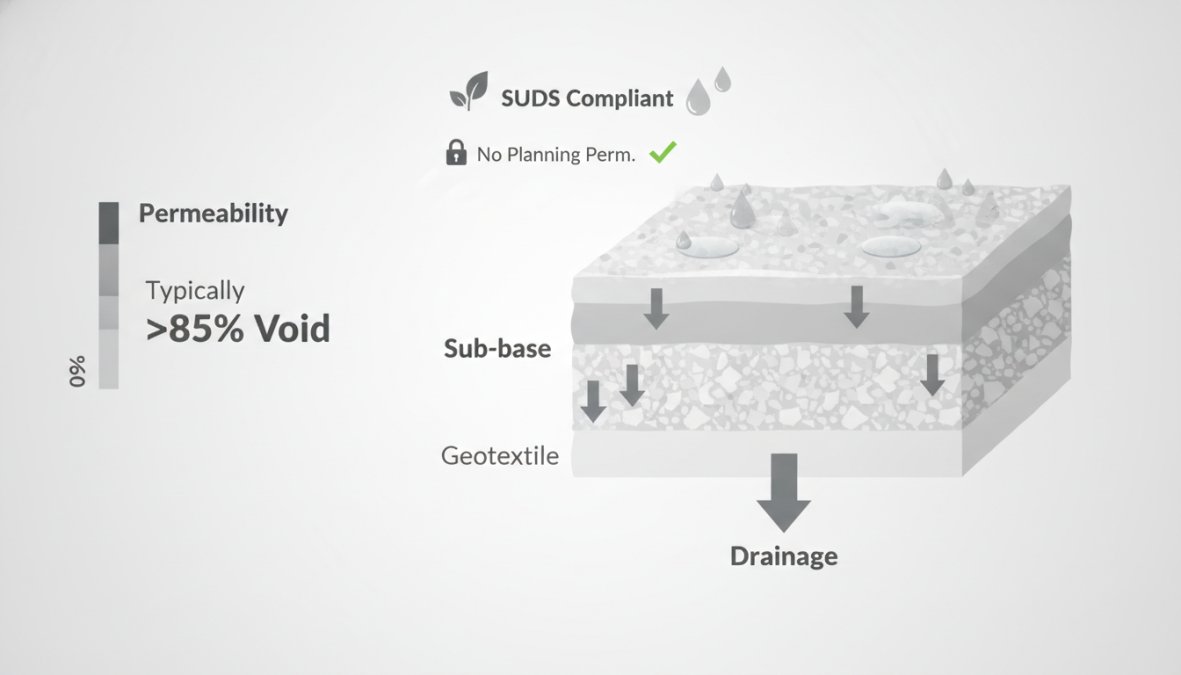
A typical SUDS-compliant installation includes excavation to appropriate depth (150-200mm), removal of unsuitable material, compacted sub-base layer, geotextile membrane, permeable resin bound surfacing, and drainage provisions. Many homeowners assume they can apply resin bound material over existing surfaces, but this fails SUDS requirements because existing concrete or tarmac is impermeable.
Dropped Kerb Planning Permission and Resin Driveway Installation Process
Installing a new driveway often requires a dropped kerb, the lowered section of pavement where your driveway meets the road. This requires separate formal consent from the local highway authority, even if your resin driveway qualifies for permitted development rights. The process typically takes 4-8 weeks.
The installation process follows a structured sequence: site survey to establish ground conditions and check for utilities; groundworks including excavation and base layer compaction; geotextile membrane and drainage installation; and finally resin bound surface application. Resin bound installation requires dry conditions and specific temperature ranges, typically spring through autumn.
| Installation Phase | Duration | Key Consideration |
|---|---|---|
| Site survey and planning approval | 2-4 weeks | Dropped kerb consent takes longest |
| Groundworks and sub-base | 3-5 days | Weather-dependent; requires dry conditions |
| Geotextile and drainage installation | 1-2 days | Precision work; affects long-term performance |
| Resin bound application | 1-2 days | Temperature and humidity critical |
| Curing and full use | 3-7 days | Avoid heavy traffic during cure period |
One frequently overlooked aspect is the relationship with neighbouring properties. If your installation affects surface water drainage to adjacent land, you may need consent from those neighbours.
The entire process from initial consultation to a fully usable, regulation-compliant driveway typically spans 8-12 weeks. Planning and highways approvals account for most of this time; actual installation takes just 5-7 days.
When Is Planning Permission Actually Required?
Planning permission becomes mandatory in specific circumstances. Properties in conservation areas require planning consent for any new driveway, regardless of size or surface type. Listed buildings and their curtilages have similar restrictions, as do properties within areas of outstanding natural beauty.
If your property already has a driveway and you’re simply resurfacing it with resin bound material, you typically need no planning permission. However, creating a new driveway where none existed, or significantly enlarging an existing one, may require permission, particularly if the new hard-surfaced area exceeds local thresholds (often around 5 square metres).
A third trigger is impact on flood risk. Properties in flood-risk zones installing impermeable driveways may require planning permission. Conversely, installing a permeable resin bound driveway often helps satisfy flood-risk requirements.
Common Mistakes Homeowners Make With Planning Permission
Homeowners frequently assume that if a neighbour installed a driveway without permission, they can do the same. Enforcement is discretionary; relying on this inconsistency is a gamble.
A second mistake involves conflating planning permission with building regulations. They’re separate requirements. Skipping building regulation approval can result in enforcement action, difficulty selling the property, or insurance complications.
A third common error is selecting a surface based purely on cost without considering regulatory implications. A budget resin bonded installation over concrete may seem economical initially but could require costly removal and replacement if it doesn’t meet SUDS requirements.
Homeowners also underestimate approval timelines, planning installations in three weeks without realising dropped kerb consent alone takes 4-8 weeks.
Planning permission for a resin bound driveway requires understanding permitted development rights, SUDS compliance, and your specific property circumstances. Most residential driveways qualify for exemption from planning permission if they’re permeable and outside conservation areas. Ensuring compliance with building regulations and sustainable drainage standards is essential. With proper guidance and experienced installation, you can deliver a compliant, durable driveway that passes inspection and stands the test of time.
Frequently Asked Questions
What is the difference between resin bound and resin bonded driveways regarding planning permission?
Resin bound driveways feature aggregate set within polyurethane resin, creating a permeable porous surface that typically qualifies as permitted development in most cases. Resin bonded driveways use resin as a thin bonding layer over existing surfaces and are generally considered non-porous. The permeability of resin bound surfaces often exempts them from planning permission requirements, whilst resin bonded installations may require approval depending on local drainage regulations and whether they affect surface water runoff management.
Does the 5 square metre rule apply to resin bound driveways?
Yes, the 5 square metre rule is a key part of permitted development rights for hard landscaping, including resin bound driveways. However, this rule applies differently depending on your property's location and whether you're in a conservation area or near a listed building. In most cases, you can install or replace up to 5 square metres of permeable paving without planning consent. Always check with your local planning authority, as some councils have stricter requirements or different thresholds for property frontages.
Are there exceptions where planning permission IS required for a resin bound driveway?
Yes, planning permission becomes mandatory in several situations: properties in conservation areas, listed buildings, or those with article 4 directions; installations exceeding 5 square metres; driveways that create flood risk or drainage problems; and projects affecting visibility splays at dropped kerbs. Additionally, if your property is in a flood risk zone or subject to environmental agency restrictions, you may need planning consent. A site survey by your local planning authority can clarify your specific circumstances before installation begins.
How do SUDS regulations affect my resin bound driveway installation?
SUDS (Sustainable Drainage Systems) regulations require that surface water runoff from hard landscaping be managed sustainably. Resin bound driveways are SUDS compliant because they're permeable, allowing water to drain through the surface rather than creating impermeable barriers. This compliance often eliminates planning permission requirements and reduces flood risk. However, your sub-base must include proper soakaway provisions or groundworks that meet building regulations. Your installer should conduct a site survey to ensure your driveway design meets local drainage standards and environmental agency requirements.


