

Table of Contents
- Can You Put Tar and Chip Over an Existing Driveway?
- Tar and Chip Driveway Installation Process
- Tar and Chip Driveway Pros and Cons
- Tar and Chip Driveway Cost and Value
Can You Put Tar and Chip Over Existing Driveway?
Last Updated: July 17, 2026
Whether you can apply tar and chip over an existing driveway depends entirely on your base surface condition. At KT Lake Paving and Landscaping, we’ve spent over 30 years evaluating driveways across Norfolk to determine which resurfacing methods work best. Tar and chip works only when the foundation is stable, if your current surface is cracked, spalling, or severely deteriorated, it will only mask problems temporarily.
Can You Apply Tar and Chip Over Existing Concrete?
Applying tar and chip over concrete is possible but requires significant preparation. Concrete’s smooth, non-porous surface resists adhesion, so the asphalt binder won’t bond effectively without intervention.
The concrete must be roughened through grinding or shot blasting to create texture for proper adhesion. This approach only works when the concrete is structurally sound with no major cracks, spalling, or heaving. If your concrete shows deterioration, white powder (efflorescence), or large fissures, tar and chip won’t solve these issues.
The process involves three steps: clean the concrete thoroughly, grind the surface to expose texture, and apply a prime coat of asphalt emulsion before laying down the tar and aggregate. This preparation typically takes longer than working over gravel, making it less economical on concrete.
If your concrete shows alligatored patterns (interconnected cracks), tar and chip won’t hold. The base is failing, and resurfacing will only delay the inevitable need for replacement.
Can You Apply Tar and Chip Over Existing Gravel?
Tar and chip works exceptionally well over loose gravel, making this the most straightforward application. Gravel’s porous base accepts the liquid asphalt binder readily, and proper compaction ensures the aggregate stays in place.
Preparation is simpler than concrete: remove large stones and debris, then compact the existing gravel firmly to create a stable sub-base. Loose gravel beneath tar and chip will shift under traffic, creating ruts within months. Once compacted, the contractor applies hot asphalt emulsion, spreads stone aggregate (typically 10-16mm chips), and performs a final compaction pass. This method has worked reliably for decades because gravel’s natural porosity ensures strong surface adhesion.
If your existing gravel driveway has developed ruts or drainage problems, address those before applying tar and chip. Poor drainage underneath will undermine the new surface faster than traffic alone.
Tar and Chip Driveway Installation Process
The installation process involves distinct steps that must be executed in sequence. Skipping any phase compromises durability.
Step 1: Surface Inspection and Preparation (2-4 hours)
The contractor assesses the existing surface for structural integrity, removes loose gravel and debris, and for concrete surfaces, grinds the top layer. This step determines whether the project can proceed as planned.
Step 2: Base Layer Compaction (2-3 hours)
The remaining base material is compacted using a vibratory plate compactor. Proper compaction prevents the tar and chip from shifting under vehicle weight. Inadequate compaction is the single most common cause of premature failure.
Step 3: Asphalt Emulsion Application (1-2 hours)
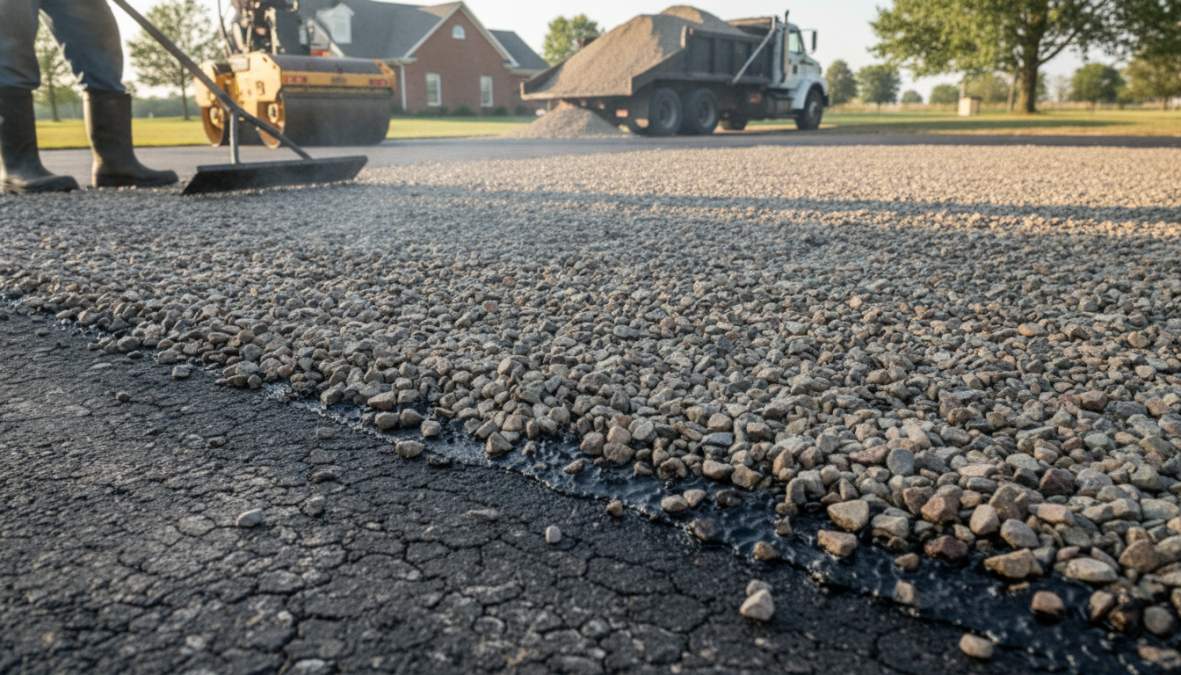
Hot-applied liquid asphalt is spread across the prepared base using a distributor truck. The binder must be applied at the correct temperature and coverage rate. Too little and the aggregate won’t adhere; too much and the surface becomes slippery in summer heat.
Step 4: Aggregate Spread and Embedding (1-2 hours)
Stone chips (typically limestone or granite) are spread evenly over the wet asphalt. The size and type affect both appearance and performance. The aggregate must be embedded into the binder before it cools.
Step 5: Final Compaction and Curing (varies)
A compaction pass locks the aggregate into the bitumen. The driveway requires curing time, typically 7-14 days before heavy traffic resumes. Weather matters; rain or extreme heat during curing can compromise the finish.
| Step | Duration | Critical Factor |
|---|---|---|
| Inspection & Prep | 2-4 hours | Surface condition assessment |
| Base Compaction | 2-3 hours | Adequate pressure application |
| Binder Application | 1-2 hours | Correct temperature and coverage |
| Aggregate Spread | 1-2 hours | Even distribution and embedding |
| Curing | 7-14 days | Weather protection and traffic control |
Tar and Chip Driveway Pros and Cons
Advantages of Tar and Chip
Tar and chip costs significantly less than asphalt or concrete resurfacing and installs quickly, most residential driveways complete in one or two days. The rustic, gravel-like appearance suits rural properties, and you can customize the look with different aggregate colors and sizes. The surface provides better traction than smooth asphalt in wet conditions.
Tar and chip works best for moderate-traffic residential driveways in good structural condition. It’s not suitable for high-traffic commercial applications or severely damaged base layers.
Disadvantages of Tar and Chip
Tar and chip typically lasts 5-7 years under normal residential traffic, compared to 15-20 years for asphalt. Loose aggregate migration is persistent, stones work free over time, scattering across your property and accumulating in gutters. The surface needs regular sweeping and sealcoating every 1-2 years to extend life.
Weather sensitivity affects performance. Heavy rain during installation can wash away aggregate. Extreme heat softens the binder, causing ruts under parked vehicles. Cold winters cause brittleness and cracking.
Tar and Chip Driveway Cost and Value
Initial installation costs are lower than alternatives, but total cost of ownership over 10-15 years often proves less favorable when you factor in maintenance, repairs, and eventual replacement.
The value equation depends on your circumstances. If you’re planning to sell within 5-7 years and need affordable curb appeal, tar and chip delivers solid value. If you’re investing long-term and want minimal maintenance, the lower upfront cost becomes less attractive when spread across the driveway’s lifespan. A properly installed surface with good drainage and regular sealcoating lasts longer and requires fewer emergency repairs.
Deciding whether to apply tar and chip requires honest assessment of your base layer condition, traffic patterns, and maintenance tolerance. The method works well for stable gravel foundations and light-to-moderate residential use, but fails quickly when the underlying structure is compromised. KT Lake Paving and Landscaping brings 30 years of Norfolk experience to this decision. Contact us for a free estimate to evaluate whether tar and chip resurfacing makes sense for your property, or whether alternative solutions would serve you better.
Frequently Asked Questions
Can you apply tar and chip directly over concrete?
Applying tar and chip over existing concrete is possible but requires extensive preparation. Concrete must be cleaned, any spalling concrete removed, and the surface roughened to improve surface adhesion. The concrete should be structurally sound with proper drainage. If the concrete is severely damaged or poorly drained, resurfacing with tar and chip may not be advisable. A professional assessment ensures your substrate is suitable before application begins.
What is the typical tar and chip driveway cost for resurfacing?
Tar and chip driveway cost varies based on driveway size, substrate condition, stone size selection, and local labour rates. Pricing depends on quantity, dates, and delivery logistics. For a detailed quote specific to your property, contact KT Lake Paving and Landscaping for a free, no-obligation estimate. As a Brett Approved Premier Installer with over 30 years of experience, we provide transparent pricing and a 10-year product guarantee on all installations.
How long does tar and chip driveway installation take?
Installation timeframe depends on driveway size and substrate condition. Surface preparation, including cleaning, repairs, and compaction of the base layer, typically takes one to two days. Application of liquid asphalt emulsion and aggregate follows, taking additional time. Curing time varies by climate and weather conditions, generally requiring 7-14 days before full traffic load tolerance. Professional installers can advise on the specific timeline for your project.
What are the main disadvantages of tar and chip driveways?
Tar and chip surfaces require regular maintenance, including dust control measures and occasional re-sealing to prevent weatherproofing degradation. Stone can loosen over time, particularly under heavy traffic load. In very hot climates, the binder may soften; in cold regions, freeze-thaw cycles can affect durability. Alligatored or spalling surfaces may develop if the base layer lacks proper drainage or compaction. Skid resistance can decrease as the surface ages, requiring sealcoating to restore grip.


