

Table of Contents
- Is Tar and Chip Good for Steep Driveways? Key Considerations
- Tar and Chip Driveway Pros and Cons for Steep Slopes
- Tar and Chip vs Tarmac for Steep Driveways
- Driveway Drainage for Steep Slopes: Engineering the Right Solution
Last Updated: July 27, 2026
Is Tar and Chip Good for Steep Driveways? Key Considerations
When asking "is tar and chip good for steep driveways," homeowners face a genuine dilemma. This surfacing option delivers excellent traction and durability on inclines, yet it requires careful installation and ongoing maintenance to perform well long-term. The short answer is yes, tar and chip works well for steep driveways when the base is properly prepared and drainage is engineered correctly. However, not every slope suits this material equally, and several competing options exist depending on your specific gradient and climate conditions.
Tar and Chip Driveway Pros and Cons for Steep Slopes
Assessing whether tar and chip is suitable for your steep driveway requires understanding both its genuine strengths and honest limitations. This surface dressing combines hot bitumen with aggregate stones, creating a flexible, permeable finish that performs differently on slopes than on flat surfaces.
Advantages for steep inclines:
Tar and chip provides superior traction through loose aggregate, offering excellent friction in wet or frosty weather, particularly valuable in Norfolk winters. It’s naturally permeable, allowing water to drain through the surface rather than pooling, which reduces erosion risk. The material accommodates ground movement and thermal expansion better than rigid alternatives, offers distinctive aesthetic appeal, and costs less than resin-bound or concrete options.
Disadvantages and real limitations:
Aggregate stones gradually work loose on steep gradients, requiring periodic top-dressing. Regular maintenance, pressure washing, stone replacement, and binder resealing, is necessary to extend lifespan. Durability varies significantly with slope angle; beyond 1-in-8 gradient, loose stone becomes increasingly problematic. Prolonged wet conditions and freeze-thaw cycles break down the bitumen binder faster than on gentler slopes.
| Aspect | Advantage | Disadvantage | Severity on Steep Slopes |
|---|---|---|---|
| Traction | Excellent grip in wet/frost | None | Low risk |
| Drainage | Naturally permeable | Requires proper sub-base | Medium risk |
| Maintenance | Cost-effective upfront | Ongoing top-dressing needed | High impact |
| Durability | 7-10 years typical | Shorter on very steep grades | High risk |
| Installation | Relatively quick | Base preparation critical | High impact |
Tar and Chip vs Tarmac for Steep Driveways
Tar and chip is a surface dressing where hot bitumen is sprayed onto a prepared base, then aggregate is immediately rolled in, creating a semi-bound surface. Tarmac (asphalt) is fully bound, with aggregate mixed with bitumen before laying, creating a solid, impermeable surface that’s denser but less flexible.
On steep driveways, tarmac develops problems that tar and chip avoids. Cracks propagate quickly due to thermal stress and water infiltration, weakening the sub-base and accelerating deterioration. Tar and chip remains flexible; small cracks don’t propagate because the surface can move with ground settlement, and water drains through rather than pooling behind cracks.
On slopes steeper than 1-in-8, tar and chip typically outperforms tarmac over a 10-year period. Tarmac’s rigidity becomes a liability rather than an asset.
Tarmac requires crack sealing and patching every 2-3 years on steep slopes. Tar and chip needs occasional stone top-dressing but fewer structural repairs, often favouring tar and chip on gradients above 1-in-10 over the total cost of ownership. In frosty conditions, tar and chip’s permeable structure allows water to drain rather than freezing on the surface, reducing ice formation.
Driveway Drainage for Steep Slopes: Engineering the Right Solution
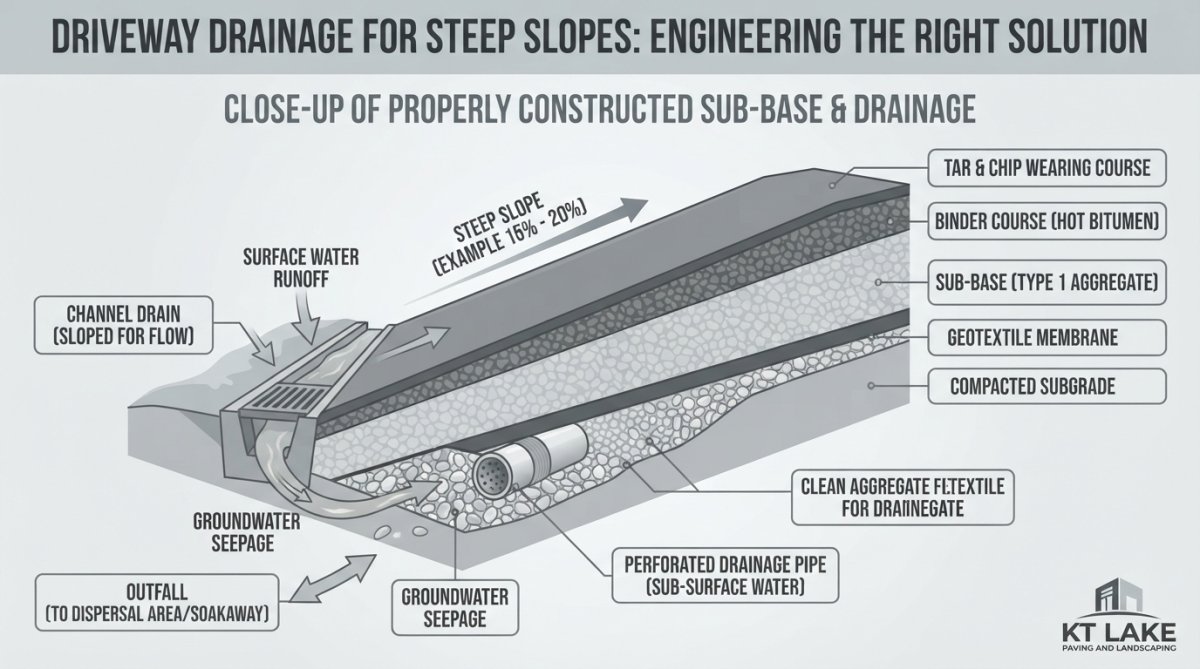
The difference between a successful tar and chip driveway on a steep slope and a failing one comes down to drainage engineering. Water running down a steep driveway carries tremendous force; without proper engineering, water concentrates in channels, erodes the sub-base, and destabilises the surface.
Sub-base preparation:
The foundation beneath tar and chip must be engineered specifically for steep slopes. A 100-150mm layer of compacted Type 1 aggregate (MOT Type 1 or equivalent) provides a stable, permeable base, properly compacted to 95% Standard Proctor density. The sub-base should follow the driveway gradient to ensure water drains along the slope rather than pooling. On very steep slopes (1-in-6 or steeper), shallow channels cut into the sub-base at intervals direct water sideways. A permeable geotextile membrane between the sub-base and tar and chip surface prevents fine particles from washing into the aggregate, which clogs drainage pathways.
Surface-level water management:
Slightly higher edges channel water toward the centre, preventing sideways runoff and verge erosion. A shallow trench or swale at the bottom of the slope catches runoff and directs it away from the property. Regular cleaning keeps the surface free of moss, leaves, and debris, maintaining permeability.
Skipping proper drainage engineering on slopes steeper than 1-in-10 will result in sub-base erosion within 3-5 years, causing surface deformation and premature failure. This is the single most common cause of tar and chip failure on steep driveways.
Norfolk’s climate presents specific drainage challenges with significant winter rainfall and freeze-thaw cycles. Poorly drained tar and chip becomes waterlogged, and repeated freezing weakens the bitumen binder. Proper drainage engineering is essential for driveway longevity in Norfolk.
Why Base Preparation Determines Success or Failure
Installation quality separates successful tar and chip driveways from those that deteriorate rapidly. A proper base begins with removing existing material and excavating to a stable substrate. Any soft spots, clay lenses, or organic material must be removed and replaced with compacted aggregate.
The aggregate layer requires careful selection and placement. Type 1 aggregate, properly graded and compacted, is the industry standard. Compaction is critical; achieving 95% Standard Proctor density requires proper equipment and multiple passes. Inadequately compacted bases settle over months and years, creating depressions that concentrate water and accelerate surface failure. A properly prepared base supports the tar and chip surface for 8-10 years. A poorly prepared base fails within 3-5 years.
Durability and Long-Term Performance on Steep Slopes
The realistic lifespan of tar and chip on a steep driveway depends on slope gradient, climate, maintenance, and installation quality. On gentle slopes (1-in-20 or less), tar and chip typically lasts 10-12 years. On steep slopes (1-in-8 to 1-in-10), expect 7-9 years. On very steep slopes (steeper than 1-in-8), durability drops to 5-7 years unless maintenance is exceptional.
Rather than waiting for complete failure, many homeowners adopt a planned resurfacing approach. After 6-8 years, applying a fresh tar and chip layer or switching to a more durable alternative like resin-bound extends the driveway life cost-effectively.
Aesthetic Appeal and Kerb Value
Tar and chip delivers genuine aesthetic advantages. The speckled surface has character and visual warmth that plain tarmac lacks. For Norfolk properties where kerb appeal influences property value, this matters. Colour customisation is possible by selecting different aggregate types, lighter stones for a warmer appearance, darker aggregates for a more formal look. However, maintenance is required to keep aesthetic appeal intact. A neglected tar and chip driveway looks tired within a few years, whereas a maintained one remains visually appealing throughout its lifespan.
Deciding whether tar and chip is suitable for your steep driveway requires honest assessment of your slope gradient, drainage conditions, and willingness to maintain the surface. For most Norfolk properties with slopes between 1-in-8 and 1-in-12, tar and chip offers excellent value and performance, provided the base is engineered correctly and drainage is managed.
If you’re uncertain about your specific slope or drainage requirements, KT Lake Paving and Landscaping offers free, no-obligation consultations. Our team can assess your driveway’s gradient, evaluate drainage needs, and recommend whether tar and chip, resin-bound, or another surfacing option suits your property best. With over 30 years of experience and Brett Approved Premier Installer status, we ensure every installation meets rigorous British Standards and comes backed by a 10-year product guarantee.
Frequently Asked Questions
Is tar and chip good for steep driveways, or should I choose something else?
Tar and chip can work on steep driveways if the slope gradient is moderate (typically under 1 in 8) and drainage is properly engineered. However, steeper inclines, particularly those exceeding 1 in 6, present challenges with loose stone migration and water runoff. The suitability depends on your specific slope angle, local climate, and maintenance commitment. For very steep slopes, alternatives like asphalt or concrete may offer superior durability and traction.
What are the main disadvantages of a tar and chip driveway on a slope?
The primary drawbacks include loose stone displacement on steep gradients, particularly during freeze-thaw cycles common in frosty weather. Water drainage becomes critical, poor sub-base preparation can lead to erosion and surface breakdown. Tar and chip also requires more frequent maintenance on inclines, including pressure washing and occasional resealing. In wet conditions, the aggregate surface can become slippery without proper grit specification.
How does tar and chip compare to tarmac for steep driveways?
Tarmac (asphalt) offers superior durability and better traction on steep slopes compared to tar and chip. Tarmac is less prone to loose stone loss and handles freeze-thaw cycles more reliably. However, tar and chip typically provides better aesthetic appeal and kerb kerb appeal with its natural aggregate finish. Tarmac requires less frequent maintenance but may be less forgiving during initial installation on steep gradients if base preparation is inadequate.
What maintenance does a tar and chip driveway on a slope require?
Steep tar and chip driveways need regular pressure washing to remove debris and prevent moss growth, which accelerates erosion. Inspect for loose stone migration and top-dress as needed, typically every 2-3 years depending on weather exposure. Monitor drainage channels to ensure water flows away from the surface. In areas with harsh winters, frosty weather can weaken the binder, so annual inspection before winter is essential. Avoid using salt-based de-icers, which can damage the bitumen.
What's the typical lifespan of a tar and chip driveway on a steep slope?
On steep gradients with proper base preparation and maintenance, tar and chip typically lasts 7-10 years. However, lifespan is shorter than on level driveways due to accelerated wear from water runoff and stone loss. Durability improves significantly with excellent drainage engineering and a well-compacted sub-base. Harsh weather, particularly wet conditions and repeated freeze-thaw cycles, can reduce longevity. Regular maintenance and timely resealing can extend the driveway lifespan by several years.


