

Table of Contents
- Why Weeds Grow in Block Paving Joints and How to Stop Them
- Manual Weeding and Root Removal Techniques
- Polymeric Sand for Block Paving: A Long-Term Prevention Solution
- Sealing Block Paving to Stop Weeds: Chemical and Eco-Friendly Options
How to Stop Weeds in Block Paving Joints: A Complete Guide
Last Updated: July 26, 2026
Weeds sprouting through block paving joints are one of the most persistent maintenance headaches for homeowners across Norfolk and beyond. Uncontrolled weed growth can destabilise joints, compromise surface integrity, and create a breeding ground for moss and algae. At KT Lake Paving and Landscaping, we’ve spent over 30 years helping property owners tackle this problem with practical, proven methods. The real solution combines immediate removal with preventative measures that address why weeds grow in the first place.
Why Weeds Grow in Block Paving Joints and How to Stop Them
Weeds exploit the specific conditions block paving creates: loose jointing sand, moisture retention, and protection from foot traffic. Block paving joints are essentially small gardens containing loose sand, organic matter from leaves and debris, and consistent moisture from rainfall. Weed seeds blow in constantly and find ideal germination conditions. The joints also shield seedlings from wind and direct sunlight that would stress them on open ground.
You’re actually managing three separate issues: existing weeds with established root systems, the jointing sand that harbours seeds, and environmental conditions that favour regrowth. Addressing all three stops weeds from coming back.
Ignoring weed growth for more than a few weeks allows taproots to establish deep into the joint base. Once roots exceed 5cm depth, manual removal becomes exponentially harder and often leaves fragments behind that regrow.
Manual Weeding and Root Removal Techniques
The most immediate way to stop weeds in block paving joints is removing them completely, roots and all. Pulling from the stem leaves the root intact, guaranteeing regrowth within days.
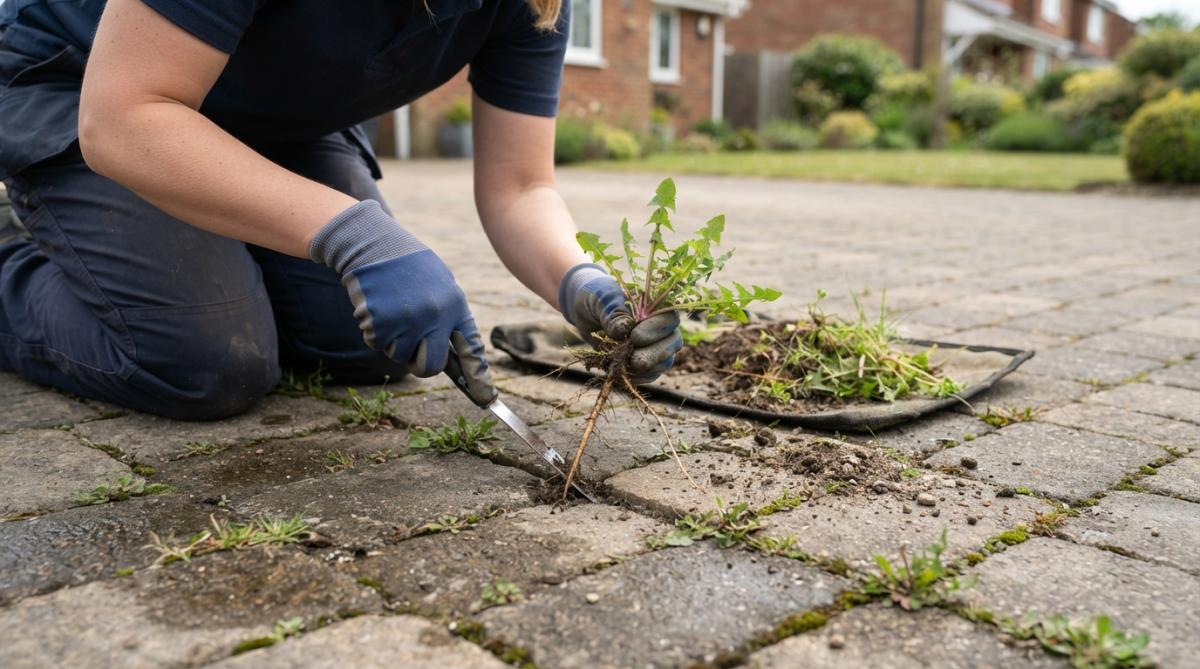
A weeding knife (also called a daisy grubber or patio weeder) is essential. These have a forked or blade-like end that slides under the weed to dislodge the root without damaging surrounding blocks.
Here’s the correct technique:
- Water the joints lightly 30 minutes before weeding. Damp soil grips the root better and prevents it snapping off underground.
- Position the tool at the base of the weed, angled slightly under the root. Slide it down alongside the taproot rather than stabbing downward.
- Apply steady downward pressure whilst rocking the handle gently to lift the entire root.
- Extract slowly. Rushing causes the root to snap. If resistance increases, angle the tool differently rather than forcing it.
- Inspect the hole. If any root fragment remains, use the tool again to remove it. Fragments as small as 2cm can regrow.
- Refill with kiln-dried sand immediately to prevent water traps and new seed germination.
Early morning is ideal because weeds are fully hydrated and roots release more easily. Avoid weeding in dry conditions or after hot weather, when roots become brittle and snap.
Keep a small bucket of kiln-dried sand next to you whilst weeding. Refilling immediately prevents the joint from becoming a water trap and stops new seeds from settling into the gap.
Polymeric Sand for Block Paving: A Long-Term Prevention Solution
Once you’ve removed existing weeds, polymeric sand is the most effective long-term barrier against regrowth. Unlike standard jointing sand, polymeric sand contains binding agents that harden when moistened, creating a semi-solid barrier that prevents weed seeds from settling into the joint.
The installation process is straightforward:
- Remove old jointing sand completely. Sweep out loose sand from all joints using a stiff brush. Use a pressure washer on low setting (below 100 bar) to dislodge compacted sand without damaging the blocks. Allow 24 hours for joints to dry completely.
- Apply polymeric sand. Pour the sand into joints and sweep it across the surface, working it into gaps with a broom. Overfill slightly, the sand will settle.
- Activate with water. Use a fine mist spray, not a jet. Start at one corner and work systematically across the patio. The water should dampen the sand without pooling.
- Allow 24-48 hours curing time before allowing foot traffic.
Polymeric sand reduces sand migration and improves the structural integrity of the paving surface, particularly valuable on sloped driveways or areas with heavy foot traffic.
| Jointing Method | Weed Prevention | Installation Time | Maintenance |
|---|---|---|---|
| Standard sand | Poor, requires frequent weeding | 2-3 hours | Weekly weeding, annual retopping |
| Polymeric sand | Excellent, blocks seed germination | 3-4 hours | Annual inspection, occasional retopping |
| Sealing only | Moderate, depends on sealer type | 2-3 hours | Annual resealing required |
Polymeric sand is most effective when combined with sealing. The sealer protects the polymer from UV degradation, extending its lifespan significantly.
Sealing Block Paving to Stop Weeds: Chemical and Eco-Friendly Options
Sealing the surface of block paving creates a protective barrier that reduces water penetration into joints and makes the surface hostile to weed growth. Chemical sealers contain polymeric resins that harden to form a protective film, whilst eco-friendly, water-based alternatives use plant-derived resins with lower environmental impact.
The application process is identical regardless of type:
- Clean the paving thoroughly. Remove all debris, moss, and algae using a pressure washer (100-120 bar maximum). Allow 48 hours for complete drying.
- Apply the sealer. Use a roller or sprayer, working in sections. Apply thin, even coats rather than one thick coat.
- Cure time varies. Most sealers require 24-72 hours before rain exposure. Check the product instructions.
- Reapply annually. Sealer degrades under UV exposure and foot traffic.
A sealed surface reduces water penetration, which means less moisture in the joints. Weeds need consistent moisture to germinate and establish. Combining sealing with polymeric sand creates the most comprehensive prevention system.
Never apply sealer to freshly installed paving or over wet joints. Moisture trapped beneath the sealer can cause discolouration and reduce adhesion. Wait at least 2 weeks after installation or joint treatment before sealing.
Preventative Maintenance Schedule for Norfolk Properties
Stopping weeds permanently requires ongoing attention. A structured maintenance schedule prevents small problems from becoming major ones.
Monthly (March to October):
- Inspect joints for new weed growth and remove immediately.
- Sweep debris from the surface. Fallen leaves trap moisture and provide nutrients for weed seeds.
Quarterly:
- Deep clean using a pressure washer on low setting (below 100 bar).
- Inspect joint depth and plan retopping if needed.
Annually (autumn recommended):
- Retop joints with polymeric sand if necessary.
- Reseal the surface if using a sealer.
- Assess overall paving condition for sinking sections or cracked blocks.
Every 3-5 years:
- Consider full joint stabilisation if polymeric sand is degrading or weeds are returning despite maintenance.
Shaded areas, low-lying sections, and properties with poor drainage need more frequent attention. After the first year of consistent maintenance, weed pressure typically drops significantly.
Autumn is the worst season for weed growth in Norfolk because cooler temperatures and increased rainfall create ideal germination conditions. Increase inspection frequency in September and October to catch new growth before roots establish.
Persistent weeds in block paving joints aren’t inevitable, they’re a sign that your current prevention system isn’t matching the growing conditions on your property. The combination of manual removal, polymeric sand, and annual sealing creates a system that actually works. KT Lake Paving and Landscaping brings over 30 years of experience installing and maintaining block paving across Norfolk. Our Brett Approved installation standards ensure that any new paving work includes proper joint preparation and sealing from the start. Contact us for a free consultation to assess your paving and discuss a maintenance plan tailored to your property’s specific conditions.
Frequently Asked Questions
Why do weeds keep growing back in block paving joints even after I remove them?
Weeds regrow because taproots and root fragments remain in the joints, allowing the plant to regenerate. Manual weeding alone removes only the visible portion. To prevent regrowth, you must address joint depth by using kiln-dried sand or block paving sealers that create a barrier against new seeds. A maintenance schedule combining removal, sealing, and preventative treatments delivers the best long-term results for weed suppression.
Is polymeric sand for block paving effective at preventing weeds?
Yes, polymeric sand is highly effective for weed prevention when properly applied. Kiln-dried sand hardens when activated with water, creating joint stabilisation that compacts tightly and prevents seeds from settling in gaps. This method works best as part of a comprehensive approach: first remove existing weeds thoroughly, apply the polymeric sand into clean joints, then seal the surface. Regular maintenance keeps the joints intact and prevents weed growth for years.
What's the difference between chemical herbicides and natural weed killer for block paving?
Chemical herbicides work quickly to kill weeds but may require reapplication and can affect surrounding plants. Natural weed killers, such as pressure washing, weed torching, and organic herbicides, are safer for families and pets but may need more frequent treatment. For long-term results, combine either option with sealing block paving to stop weeds at the source. Environmental impact and your maintenance commitment should guide your choice.
Should I hire a professional or tackle weed prevention myself?
DIY maintenance works well for small areas and regular upkeep, but professional sealing and polymeric sand installation often deliver superior long-term results. Professionals ensure proper surface preparation, correct joint depth, and quality application, factors that directly affect how well block paving sealers and kiln-dried sand perform. For Norfolk properties, a free estimate from an experienced installer can clarify whether your situation suits DIY care or professional treatment.


