

Table of Contents
- What is SuDS Compliance for Resin Driveways?
- Resin Bound vs Resin Bonded Permeability: Which Meets SuDS Standards?
- Permeable Sub-Base Requirements for Resin Driveways
- SuDS Planning Permission Rules UK: What You Need to Know
Last Updated: August 3, 2026
What is SuDS Compliance for Resin Driveways?
SuDS stands for Sustainable Urban Drainage Systems, regulations designed to manage surface water runoff by mimicking natural drainage patterns. Permeable surfaces allow rainwater to infiltrate through the driveway into the ground below, reducing flooding risk and recharging groundwater. For resin driveways, SuDS compliance means the installation must allow surface water to drain through the resin surface and into a permeable sub-base beneath.
SuDS compliance is now a [planning permission requirement](/planning-permission-resin-bound-driveway/) in many parts of Norfolk. Properties that fail to meet these standards may face enforcement action or difficulties when selling.
Building Regulations Part H establishes that driveways covering more than 5 square metres typically require SuDS-compliant drainage solutions. Compliance depends on three factors: the permeability of the resin surface, the quality of the sub-base underneath, and the drainage infrastructure that channels water away safely.
Resin Bound vs Resin Bonded Permeability: Which Meets SuDS Standards?
Resin-bound surfaces consist of decorative aggregate mixed thoroughly with liquid resin before installation. This creates a porous material where water passes through void spaces between aggregate particles. When properly installed, resin-bound driveways are genuinely permeable and can achieve SuDS compliance, with porosity typically ranging from 15-20% void space.
Resin-bonded surfaces involve scattering aggregate across wet resin, creating a textured appearance but leaving the resin layer relatively impermeable. Water sits on top rather than passing through. Whilst resin-bonded driveways offer excellent durability, they cannot meet SuDS requirements on their own and require additional drainage solutions.
For SuDS compliance in Norfolk, resin-bound is the correct choice. Resin-bonded surfaces must be paired with alternative drainage systems to satisfy building regulations.
Permeable Sub-Base Requirements for Resin Driveways
The resin surface is only half the equation. A permeable sub-base is the foundation layer that allows water infiltrated through the resin to continue draining downward. Without it, water pools above the driveway’s base, eventually causing cracking and sinking.
Building Regulations specify that sub-bases for SuDS-compliant driveways must consist of:
- A geotextile membrane laid across prepared ground (prevents soil migration)
- A minimum 100mm layer of permeable material, typically Type 3 or Type 1 unbound aggregate
- Proper compaction to achieve load-bearing capacity without crushing void spaces
- A soakaway or drainage channel at the lowest point to prevent pooling
Many installers mistakenly use standard tarmacadam base layers designed for impermeable driveways. These compacted bituminous materials block water flow entirely. For SuDS compliance, the sub-base must be genuinely porous.
If your driveway was installed before 2016, it almost certainly has a non-permeable sub-base. Upgrading requires complete removal and reinstallation.
SuDS Planning Permission Rules UK: What You Need to Know
For driveways covering more than 5 square metres, most local planning authorities now require evidence of SuDS compliance before granting permission. This typically involves submitting a Sustainable Drainage Statement outlining how surface water will be managed.
The Environment Agency and UK government guidance emphasise that SuDS should follow a hierarchy:
- Infiltration – water soaks into the ground on-site (best option where soil conditions allow)
- Attenuation and discharge – water is stored temporarily then released slowly to watercourses or sewers
- Discharge to public sewers – only when the above options aren’t feasible
For residential driveways, infiltration via a permeable surface and permeable sub-base satisfies the first tier. Planning applications must demonstrate that proposed drainage won’t increase flood risk to neighbouring properties.
Non-compliance can result in enforcement action requiring removal or modification of the driveway at the owner’s expense.
Step-by-Step: How to Check if Your Resin Driveway is SuDS Compliant
Step 1: Visual Surface Assessment (5 minutes)
Examine the resin surface closely. A compliant resin-bound surface should feel slightly textured with aggregate particles visible and distributed throughout. Check whether the surface shows pooling or standing water 24 hours after rain.
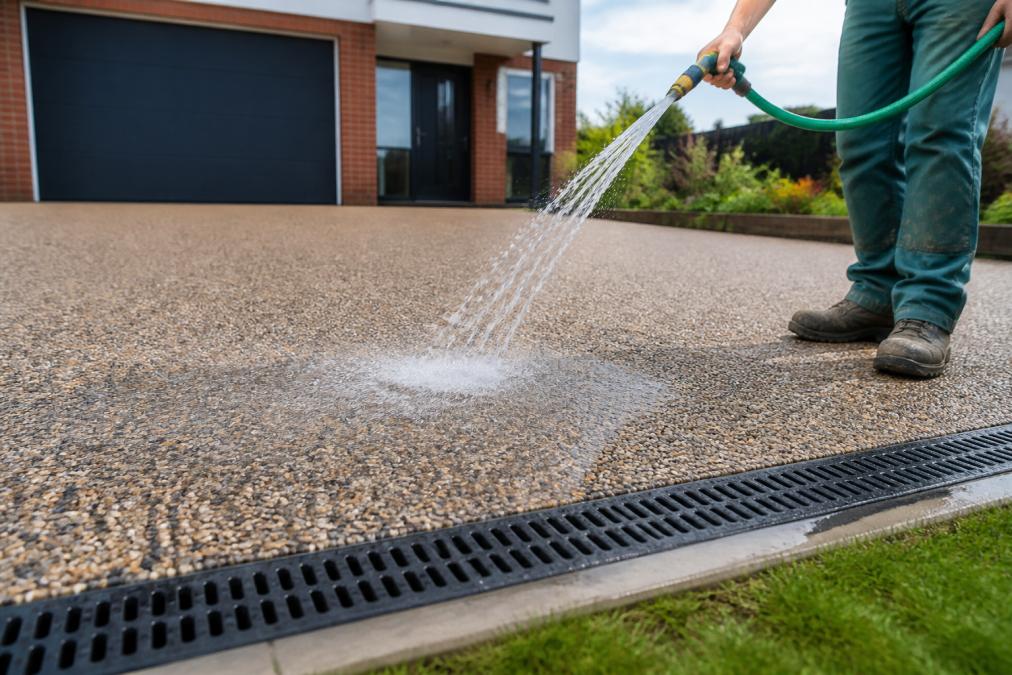
Step 2: The Hose Test (10 minutes)
On a dry day, use a garden hose to pour water onto the driveway at moderate flow rate. Compliant surfaces should drain completely within 30-60 seconds. Non-compliant surfaces will pool and run off sideways rather than drain through.
Step 3: Drainage Channel Inspection (5 minutes)
Examine any visible drainage channels, gullies, or soakaways around the driveway perimeter. These should be clear of debris and properly connected.
Step 4: Age and Installation Records (10 minutes)
Review any documentation from the original installation. Driveways installed before 2015 are unlikely to meet current SuDS standards. If records mention tarmac base, hardcore, or standard asphalt sub-base, the installation is almost certainly non-compliant.
Step 5: Soil Infiltration Test (15 minutes)
Dig a small test pit approximately 300mm deep at the driveway edge. Pour water into this pit and observe how quickly it infiltrates. If water drains within 24 hours, the ground conditions support infiltration-based SuDS.
| Test | Duration | What It Shows | Compliant Result |
|---|---|---|---|
| Visual surface check | 5 min | Surface porosity and visible damage | Textured aggregate, no pooling |
| Hose test | 10 min | Water permeability | Water drains within 30-60 seconds |
| Drainage channel inspection | 5 min | System functionality | Channels clear, water flows through |
| Installation records review | 10 min | Original design intent | Resin-bound + permeable sub-base documented |
| Soil infiltration test | 15 min | Ground drainage capacity | Water infiltrates within 24 hours |
Signs of Non-Compliant Installation and Long-Term Performance Degradation
Visible Surface Defects
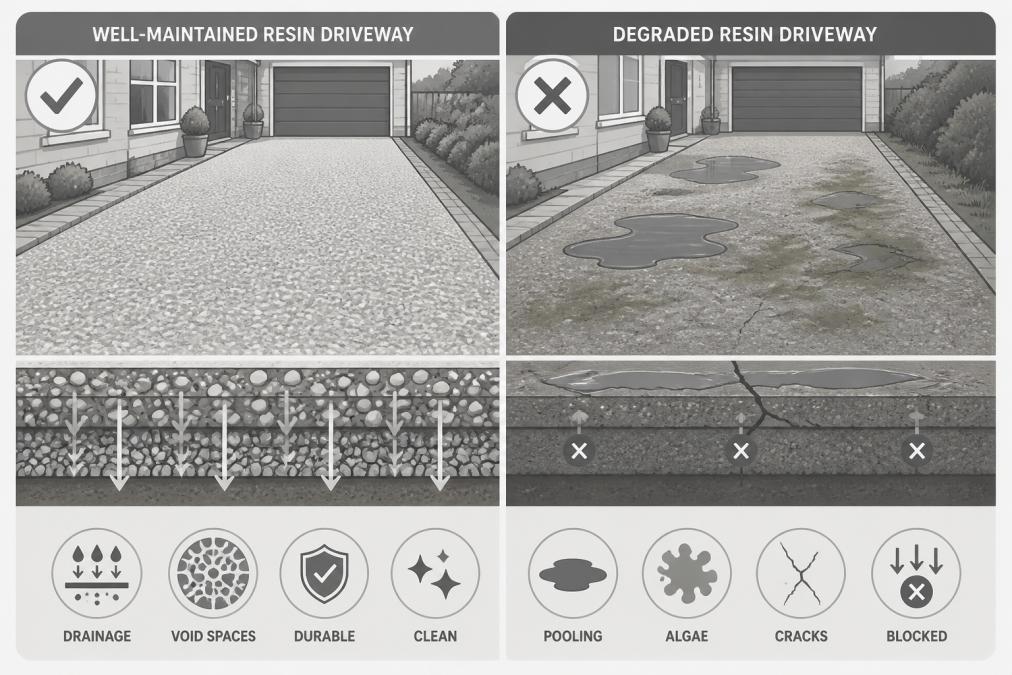
Linear cracks radiating from the centre indicate that the permeable sub-base has settled unevenly or lacks adequate compaction. Alligator cracking suggests inadequate resin ratio or sub-base compaction failure. Sinking or rutting demonstrates that the sub-base lacks load-bearing capacity.
Pooling and Drainage Failure
Standing water 24 hours after rainfall is the most obvious sign of non-compliance. Over time, pooling accelerates surface deterioration through freeze-thaw cycles and promotes algae growth.
Clogging and Infiltration Decline
Even compliant installations degrade if not maintained. Over 5-10 years, sediment, moss, and debris accumulate in void spaces, gradually reducing porosity. Regular maintenance, including annual pressure washing and prompt debris removal, prevents clogging.
Long-Term Maintenance to Preserve SuDS Compliance
Annual Pressure Washing
Pressure wash the driveway surface annually at low pressure (below 100 bar) to remove algae, moss, and accumulated sediment. This prevents clogging and maintains surface porosity.
Debris Removal
Clear fallen leaves, twigs, and sediment from drainage channels regularly. In autumn, weekly clearing may be necessary.
Inspection After Heavy Rainfall
Monitor how your driveway performs during and after heavy rain. If pooling develops where none existed before, clogging is occurring and professional cleaning is needed.
Resealing Consideration
Some resin-bound surfaces benefit from light resealing every 7-10 years. However, sealing must use permeable products specifically designed for SuDS-compliant surfaces. Standard sealers block porosity and destroy compliance.
Checking whether your resin driveway meets SuDS compliance involves straightforward visual tests and practical drainage verification. Many homeowners discover their driveways fail these tests, particularly if installed before 2015. With over 30 years of experience and Brett Approved Premier Installer status, KT Lake Paving and Landscaping ensures every installation meets rigorous British Standards and includes a 10-year product guarantee. Get started with a free, no-obligation consultation to assess your driveway’s compliance and explore solutions tailored to your property.
Frequently Asked Questions
How do I know if my resin driveway is SuDS compliant?
Check three key indicators: the surface should be visibly porous with small aggregate stones visible, water should drain through within minutes using a simple hose test, and the sub-base should contain a permeable layer (typically Type 1 aggregate or similar). If water pools on the surface or drains very slowly, your installation may not meet SuDS standards. Professional testing can measure infiltration rates to confirm compliance with Building Regulations.
What is the difference between resin bound and resin bonded driveways regarding drainage?
Resin-bound driveways are fully permeable because the resin coats individual aggregate particles, leaving void spaces for water to pass through. Resin-bonded surfaces have resin applied to the top layer only, creating a less permeable finish. For SuDS compliance, resin-bound is the superior choice as it meets infiltration rate requirements. Resin-bonded may not achieve the drainage capacity needed for Building Regulations in many UK installations.
What sub-base materials are required for a SuDS compliant resin driveway?
A SuDS-compliant resin driveway requires a permeable sub-base, typically consisting of Type 1 aggregate (unbound stone) laid to a depth of 100-150mm, followed by a geotextile membrane to prevent soil migration. The sub-base must allow water infiltration and groundwater recharge. Compaction should be minimal to preserve void space and drainage capacity. A soakaway or surface water management system may be needed depending on soil conditions and local planning requirements.
Do I need planning permission for a SuDS compliant resin driveway in Norfolk?
In most cases, a permeable resin-bound driveway does not require planning permission under Part 2 of the Town and Country Planning (Development Management Procedure) Order. However, if your property is listed, in a conservation area, or if the driveway exceeds certain size limits, planning permission may be required. Check with your local Norfolk council planning department before installation. Building Regulations approval is always necessary to ensure SuDS compliance and proper drainage design.
External Sources
[EXTERNAL_LINK: Environment Agency Sustainable Drainage Systems guidance | gov.uk]
[EXTERNAL_LINK: Building Regulations Part H Surface Water Drainage | gov.uk]
[EXTERNAL_LINK: UK Local Government Association SuDS guidance for local authorities | local.gov.uk]


