

Table of Contents
- Best Driveway Materials for Norfolk: What Works in Norfolk’s Climate
- Resin Bound vs Block Paving: Norfolk’s Top Two Options
- Permeable Driveway Materials UK Standards: Meeting Norfolk’s Drainage Requirements
- Cost of Driveway Installation Norfolk: Budget Comparison by Material
Last Updated: June 19, 2026
Choosing the best driveway materials for Norfolk properties requires understanding the county’s specific climate and drainage regulations. This guide covers every major surfacing option available to Norfolk homeowners in 2026, with honest assessments of what works in this region’s wet winters, sandy subsoils, and strict drainage requirements.
Norfolk’s coastal and low-lying geography means surface water runoff is a genuine concern. According to the Environment Agency’s flood risk guidance for East Anglia, many Norfolk postcodes carry elevated flood risk, which directly affects which driveway surfaces are legally permissible.
Best Driveway Materials for Norfolk: What Works in Norfolk’s Climate
Norfolk’s climate presents specific challenges: cold, wet winters with occasional ground frost, warm dry summers, and coastal salt-laden winds. Any driveway material must handle freeze-thaw cycles without cracking, drain surface water effectively, and resist UV degradation.
The most common mistake Norfolk homeowners make is choosing based on aesthetics alone, then discovering it fails drainage requirements. Under UK planning regulations, any new or replacement driveway over five square metres that drains onto a public road requires a permeable surface or a drainage system directing water to a soakaway or lawn.
Installing an impermeable surface such as standard tarmac or solid concrete without appropriate drainage can result in enforcement action from your local planning authority. Always confirm compliance with Norfolk County Council before installation begins.
The materials that consistently perform best in Norfolk are resin bound surfacing, permeable block paving, and gravel stabilised with grid systems.
Resin Bound vs Block Paving: Norfolk’s Top Two Options
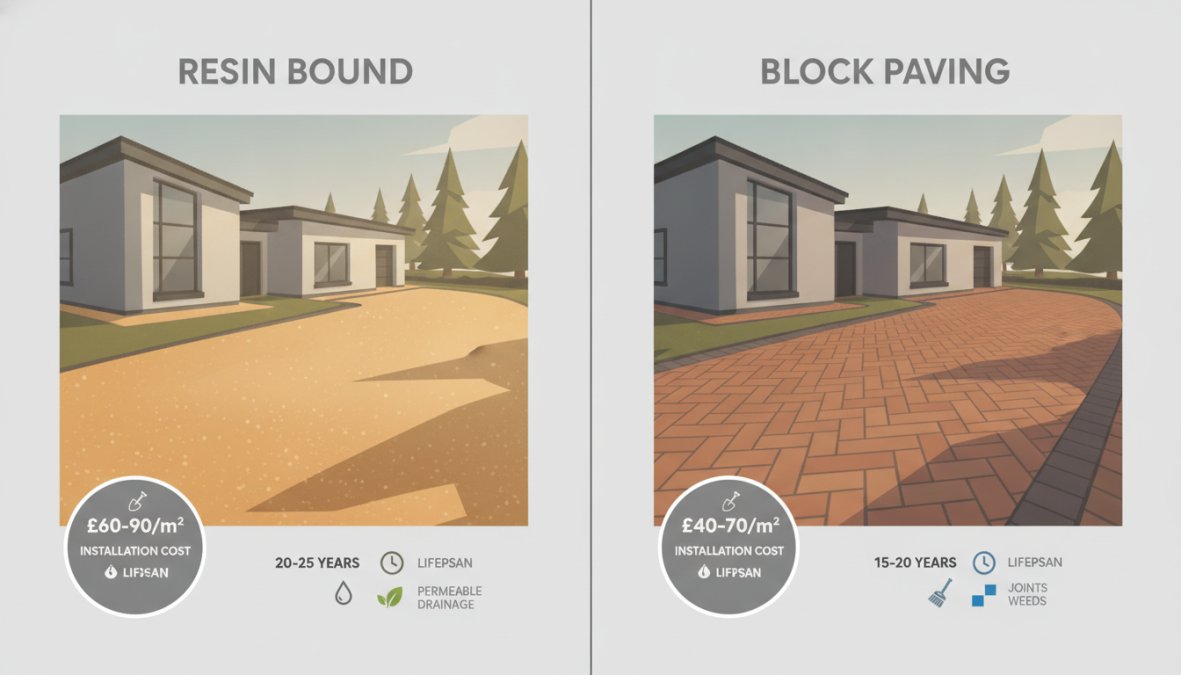
Resin bound surfacing and block paving represent the two most popular premium driveway choices across Norfolk.
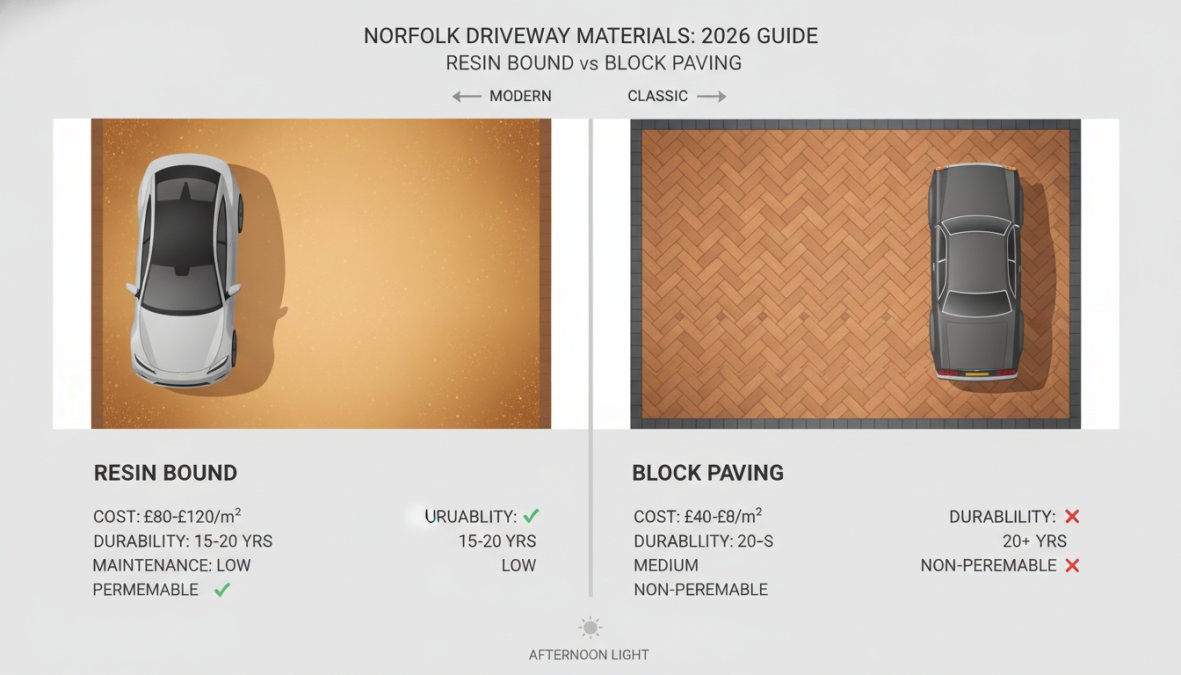
Resin bound surfacing is a fully permeable system where natural aggregate is mixed with UV-stable polyurethane resin and applied over a prepared sub-base. Water drains directly through the surface, making it fully SUDs compliant without additional drainage infrastructure. The flexible cured surface resists cracking through freeze-thaw cycles, and weed resistance is excellent. The limitation is higher upfront cost than gravel or tarmac, and it requires a structurally sound sub-base to prevent settlement.
Block paving offers individual blocks that can be lifted and replaced if damaged, making long-term repair straightforward. Permeable block paving systems meet SUDs requirements while delivering a classic look. The drawback is that joints require regular cleaning to prevent moss and weed growth in Norfolk’s damp climate.
| Feature | Resin Bound | Block Paving |
|---|---|---|
| SUDs Compliant | Yes (fully porous) | Yes (permeable system) |
| Weed Resistance | Excellent | Moderate (joint maintenance needed) |
| Repair Method | Patch repair | Individual block replacement |
| Aesthetic Options | Colour blending, aggregate variety | Patterns, colours, brickweave |
| Durability | 15-25 years with correct sub-base | 20+ years |
| Best For | Modern homes, low maintenance | Traditional properties, bespoke design |
KT Lake Paving and Landscaping, a Brett Approved Premier Installer with over 30 years of Norfolk experience, specialises in resin bound surfacing and holds a 10-year product guarantee from Brett on qualifying installations.
Permeable Driveway Materials UK Standards: Meeting Norfolk’s Drainage Requirements
Permeable paving is a category that includes several distinct systems, each meeting UK drainage standards through different mechanisms. The relevant framework is Sustainable Drainage Systems (SUDs) compliance, which requires that surface water from driveways does not increase runoff to public sewers or roads. According to the UK Government’s planning guidance on permeable surfaces and front gardens, front garden driveways must use permeable materials or include drainage directed to a garden or soakaway.
Main permeable options for Norfolk include resin bound surfacing (water passes directly through the porous aggregate matrix), permeable concrete pavers (engineered with wider joints allowing water infiltration), gravel with Nidagravel stabilisation grids (honeycomb grids hold gravel firmly while maintaining permeability), and grass grid systems (plastic or concrete grids allowing grass to grow through for fully permeable surfaces).
For Norfolk properties on sandy or free-draining soil, a resin bound surface over a permeable sub-base typically achieves SUDs compliance without needing a separate soakaway. On clay-heavy ground, a drainage engineer should assess soakaway viability before installation.
Replacing a front garden driveway with a permeable surface generally does not require planning permission in Norfolk. However, if installing an impermeable surface, adding a new dropped kerb, or working on a listed property or within a conservation area, permitted development rights may not apply. According to Norfolk County Council’s highways guidance for dropped kerbs and vehicle crossings, a separate licence is required for any new or altered vehicle crossing onto a public road.
Cost of Driveway Installation Norfolk: Budget Comparison by Material
The cost of driveway installation varies significantly by material, driveway size, and sub-base condition. These figures reflect typical 2026 quotes for standard residential driveways in Norfolk.
| Material | Approx. Cost per m² | Lifespan | Maintenance Level |
|---|---|---|---|
| Resin Bound Surfacing | Contact for quote | 15-25 years | Low |
| Block Paving | Approx. £100/m² | 20+ years | Moderate |
| Gravel with Stabilisation Grid | Low-mid range | 10-15 years | Low-moderate |
| Stone Mastic Asphalt (SMA) Tarmac | Low range | 15-20 years | Low |
| Pattern Imprinted Concrete | Mid range | 15-25 years | Very low |
| Tar and Chip | Low range | 10-15 years | Low |
| Natural Stone | Premium | 30+ years | Moderate |
Stone Mastic Asphalt remains cost-effective for large driveways or high-traffic areas. SMA resists cracking and deformation better than standard tarmac in temperature extremes. Pattern imprinted concrete mimics stone or brick at lower cost with very low maintenance, though it can become slippery when wet if not treated with anti-slip agent. Natural stone is the premium option with exceptional lifespan but requires professional installation to ensure correct drainage.
The real cost of a driveway includes sub-base preparation, drainage infrastructure for SUDs compliance, and long-term maintenance. A cheaper surface requiring annual cleaning often costs more over ten years than a higher-quality permeable installation.
For resin bound surfaces, small damaged areas can be patch repaired without visible repair marks if the original aggregate blend is matched. A structurally sound sub-base is critical for any driveway material. The standard recommendation for domestic driveways is a minimum 100mm compacted MOT Type 3 open-graded aggregate sub-base for permeable systems. According to the British Standards Institution’s guidance on flexible pavements for vehicle areas, correct sub-base specification is the single most important factor in driveway longevity.
Selecting the right driveway surface for a Norfolk property requires balancing drainage compliance, climate resilience, long-term maintenance, and budget. KT Lake Paving and Landscaping brings over 30 years of Norfolk-specific experience to every project, specialising in resin bound and tar and chip surfacing backed by a 10-year product guarantee from Brett. Get a free, no-obligation estimate and have the right surface installed correctly from the first day.
Frequently Asked Questions
What is the most durable driveway material for Norfolk's coastal climate?
Resin bound and block paving are both highly durable for Norfolk's weather. Resin bound offers superior weather resistance with UV-stable resin preventing colour fading and excellent water drainage. Block paving provides flexibility and allows individual blocks to be replaced if damaged. Both resist cracking better than standard tarmac in Norfolk's temperature fluctuations. The choice depends on whether you prioritize seamless durability (resin bound) or repairability (block paving).
Do I need planning permission for a new driveway in Norfolk?
Most driveway installations in Norfolk don't require full planning permission if they're less than 5 square metres or use permeable materials. However, larger driveways, those using impermeable surfaces, or properties in conservation areas may need approval. Check with your local Norfolk council before starting work. Permeable materials like resin bound and SUDs-compliant block paving often bypass restrictions, making them popular choices for Norfolk properties.
Is resin bound driveway suitable for Norfolk soil and drainage conditions?
Yes, resin bound is excellent for Norfolk. Its fully permeable surface allows water to drain through to the sub-base, meeting SUDs compliance requirements. This is particularly valuable in Norfolk where surface water runoff and flood risk are concerns. The UV-stable resin resists Norfolk's coastal weather, and the smooth, joint-free finish prevents weed growth. Proper sub-base preparation is essential to maximize drainage benefits.
What's the average cost of driveway installation in Norfolk, and which material offers best value?
Costs vary: block paving averages £100/m², resin bound is typically higher upfront, tarmac is budget-friendly, and natural stone is premium. However, total cost-of-ownership includes maintenance. Resin bound requires minimal upkeep, reducing long-term costs. Block paving may need joint cleaning. Tarmac requires periodic resealing. For Norfolk's climate, resin bound often provides best long-term value despite higher initial investment, thanks to durability and low maintenance demands.


