

Table of Contents
- How to Prevent Driveway Weeds: A Complete Prevention Strategy
- Best Weed Killer for Driveway Cracks: Chemical vs. Natural Options
- How to Seal Driveway Cracks to Prevent Weeds
- Natural Driveway Weed Control Methods That Work
Last Updated: June 29, 2026
Driveway weeds are a persistent outdoor maintenance challenge. At KT Lake Paving and Landscaping, we’ve spent over 30 years helping Norfolk homeowners prevent them with proven strategies. Prevention is smarter than reactive removal, stopping weeds before they germinate. According to the University of California’s integrated pest management program, preventative measures are 60-80% more cost-effective than reactive removal over five years.
| Prevention Method | Best For | Difficulty Level | Cost Range |
|---|---|---|---|
| Hand pulling | Occasional weeds | Easy | Free |
| Pre-emergent herbicides | Gravel driveways | Moderate | $20-50 |
| Landscape fabric | New installations | Moderate | $30-100 |
| Weed torches | Stone/paver driveways | Moderate | $40-150 |
| Horticultural vinegar | Eco-conscious homeowners | Easy | $15-30 |
| Proper crack sealing | All driveway types | Moderate | $100-300 |
| Boiling water | Quick spot treatment | Easy | Free |
Manual Removal and Hand Pulling
Hand pulling works best when weeds are young and soil is moist. Pull early in the morning after dew or light rain, grabbing the weed close to the soil line and pulling at a slight angle. For deep taproots, use a weeding fork to loosen soil first. In Norfolk’s clay-heavy soil, this prevents the frustrating snap-off that leaves roots intact.
Pull weeds in early morning when soil moisture is highest. This increases your success rate of removing complete root systems by up to 40%.
Hand pulling works particularly well for paver driveways. For asphalt or concrete, focus on cracks and edges.
Using Weed Torches and Propane Burners
Weed torches offer a chemical-free approach effective for stone, paver, and concrete driveways. These propane burners heat plant tissue to rupture cells, killing weeds without residue. Research from Oregon State University’s extension service on thermal weed control shows weed torches achieve 85-95% kill rates when applied correctly.
Hold the flame just above the plant for 2-3 seconds in a sweeping motion. For gravel driveways, this method avoids disturbing the aggregate surface.
Propane torches generate temperatures exceeding 2,000°F. Never use them near wooden structures, mulch, or during dry conditions. Keep a water source nearby and check local fire codes.
A quality torch ($80-150) pays for itself quickly compared to ongoing herbicide costs.
Applying Horticultural Vinegar for Natural Control
Horticultural vinegar contains 20% acetic acid, powerful enough to kill actively growing weeds on contact. Apply on a sunny day when temperatures exceed 65°F and no rain is forecast for 24 hours. The plant shows visible damage within 24 hours and complete death within 3-5 days.
Horticultural vinegar breaks down naturally without leaving persistent residue. It’s non-selective, so be careful spraying near ornamental plantings.
Mix horticultural vinegar with a small amount of dish soap to improve adhesion to waxy leaf surfaces, increasing effectiveness by improving contact time and coverage.
For gravel driveways, horticultural vinegar works well because it doesn’t create chemical barriers that accumulate in soil. Reapplication may be necessary every 2-3 weeks during growing season, costing $15-30 per season.
Pre-Emergent Herbicides for Long-Term Prevention
Pre-emergent herbicides like prodiamine and oryzalin create a barrier in the top soil layer that blocks weed seeds from sprouting. In Norfolk’s climate, apply in early spring before soil temperatures reach 55°F consistently, typically late February through March. For summer annual weeds, apply again in late April through May. The product lasts 60-90 days, requiring two applications annually.
Pre-emergents work exceptionally well for gravel driveways. For concrete and asphalt, apply to cracks and edges where soil contact allows the product to function.
Pre-emergent herbicides do not kill existing weeds. Remove all visible weeds before application, or they’ll continue growing unaffected.
Over a full season with two applications, you’re investing $40-100 for nearly complete weed prevention.
Installing Landscape Fabric as a Physical Barrier
Landscape fabric creates a permanent physical barrier preventing weed seeds from reaching soil while allowing water and nutrients to penetrate. This works best during new driveway installation or major renovation. Quality matters, thicker, non-woven fabrics (3-4 ounces per square yard) last 8-10 years or longer.
Installation requires careful preparation. Remove existing vegetation, lay fabric in overlapping strips with at least 6 inches of overlap at seams, and secure edges with landscape staples.
When installing landscape fabric under gravel, use a 2-4 inch layer to weigh down the fabric and prevent edge lifting.
The upfront investment of $30-100 pays dividends through years of reduced maintenance.
Sealing Driveway Cracks to Prevent Weed Entry
Cracks represent the primary entry point for weed seeds in concrete and asphalt driveways. Sealing cracks promptly eliminates the growing medium that allows weeds to establish.
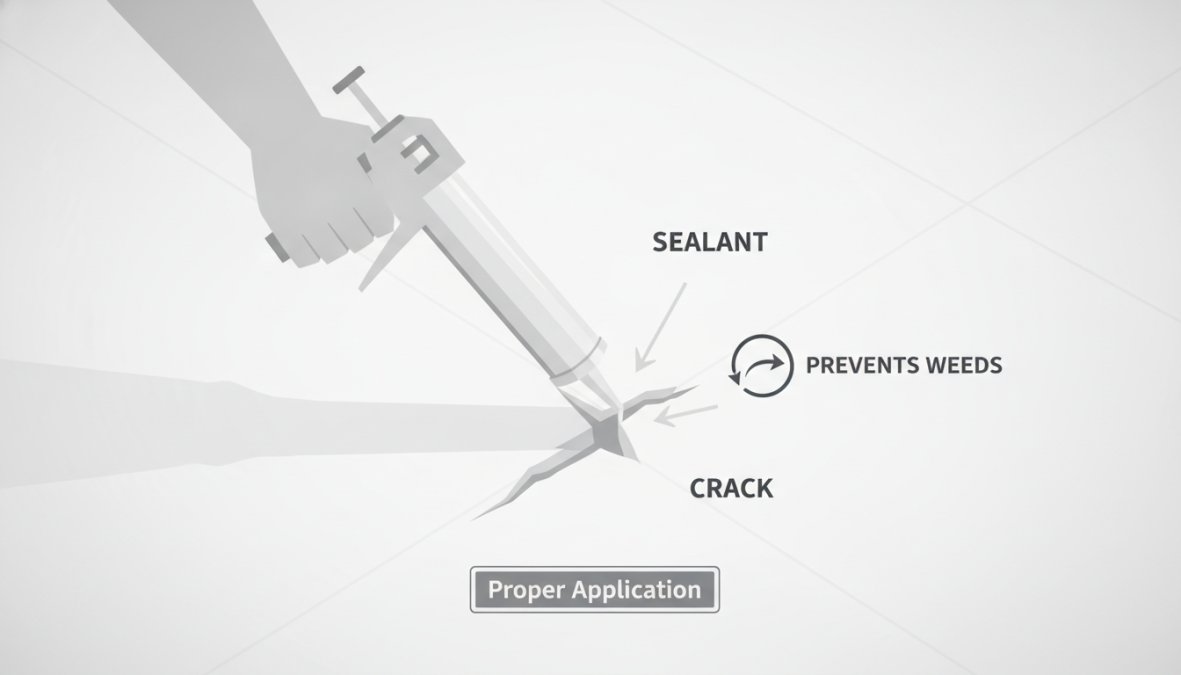
Quality crack sealant comes in two forms: liquid-applied and backer rod systems. Liquid sealants work for hairline cracks up to 1/4 inch wide. For larger cracks, install foam backer rod first, then apply sealant over top.
Clean cracks thoroughly with a pressure washer or wire brush. Allow the crack to dry completely before applying sealant on a dry day when temperatures exceed 50°F. Seal cracks every 2-3 years as part of routine maintenance. The cost of $100-300 for professional crack sealing represents excellent value compared to years of weed management in unsealed cracks.
Natural Driveway Weed Control Methods That Work
Boiling water provides an immediate, cost-free solution for spot treatment of weeds in cracks and along edges. Pour boiling water directly onto the weed, saturating both the plant and surrounding soil. This works best on young weeds before they develop extensive root systems.
Flame weeding using a weed torch qualifies as a natural method since it relies on heat rather than chemicals. Combined with manual removal, it provides comprehensive weed prevention without synthetic inputs.
A hybrid approach, using natural methods for visible weeds combined with pre-emergent herbicides for seed prevention, often delivers the best results.
Driveway weeds transform from an ongoing frustration into a manageable maintenance issue once you implement the right prevention strategy. The most effective approach combines multiple methods: sealing cracks, installing landscape fabric during new construction, and applying pre-emergent herbicides seasonally. KT Lake Paving and Landscaping offers comprehensive driveway solutions including proper installation techniques that minimize weed entry points, landscape fabric barriers, and crack sealing services. Contact us for a free, no-obligation estimate and discover how professional driveway installation prevents weeds before they start.
Frequently Asked Questions
What is the best way to prevent driveway weeds from growing in the first place?
The most effective approach combines multiple methods: seal all driveway cracks to block weed germination, apply pre-emergent herbicides like prodiamine or oryzalin in early spring before weeds sprout, and install landscape fabric under gravel driveways. For paver driveways, use polymeric sand in joints and maintain regular weeding. A consistent maintenance schedule prevents weeds from establishing root systems that become harder to remove.
Does horticultural vinegar permanently kill driveway weeds and prevent regrowth?
Horticultural vinegar (20% acetic acid) effectively dehydrates existing weeds but does not prevent future germination. It kills the visible plant but won't eliminate seeds in soil or prevent new weeds from sprouting. For permanent prevention, combine natural remedies with physical removal and crack sealing. Horticultural vinegar works best as part of a broader natural driveway weed control strategy rather than as a standalone solution.
How do I stop weeds from growing in paver driveways without damaging the pavers?
For preventing weeds in paver driveways, install landscape fabric under the pavers during installation, use polymeric sand in joints (which hardens and blocks weed growth), and maintain regular weeding before plants establish. Avoid harsh chemicals that can stain pavers; instead, use targeted herbicides on cracks only or opt for manual removal and boiling water on individual weeds. Proper drainage prevents surface runoff that can erode joint materials.
What's the difference between pre-emergent and non-selective herbicides for driveway weed prevention?
Pre-emergent herbicides (like prodiamine or oryzalin) prevent weed seeds from germinating and must be applied before weeds appear, typically in early spring. Non-selective herbicides kill existing weeds but offer no future prevention. For comprehensive weed control, use pre-emergents in spring for prevention, then apply non-selective herbicides only to active weeds that break through. Pre-emergents work best when combined with crack sealing for maximum effectiveness.


