

Table of Contents
- Resin vs Block Paving Cost: Quick Comparison
- Resin Driveway Installation Cost: What to Expect
- Resin vs Block Paving Durability: Long-Term Value
- How to Clean Block Paving and Maintain Both Surfaces
Last Updated: June 28, 2026
Resin vs Block Paving Cost: Quick Comparison
When deciding between resin and block paving for your Norfolk driveway, upfront cost tells only part of the story. The real financial picture emerges when you factor in installation complexity, long-term maintenance, and durability over 10-20 years. Both materials deliver different value propositions depending on your property’s specific needs, climate exposure, and maintenance tolerance.
The initial resin driveway installation cost typically runs lower per square metre than block paving, but block paving often wins on long-term durability and repairability. Understanding the complete cost breakdown, including sub-base preparation, labour rates in Norfolk, and hidden expenses, helps you make an informed choice.
| Comparison Factor | Resin Bound Paving | Block Paving |
|---|---|---|
| Upfront cost per m² | £40-60 | £50-80 |
| Installation time | 3-5 days | 5-7 days |
| Sub-base requirement | 100-150mm | 150-200mm |
| Maintenance frequency | Annual cleaning | Every 2-3 years |
| Typical lifespan | 7-10 years | 15-25 years |
| Repair cost (per m²) | £35-50 | £15-30 |
| Weed resistance | Excellent (SUDS compliant) | Good (requires sealing) |
| DIY feasibility | Moderate difficulty | Low difficulty |
The choice hinges on three core questions: How long do you plan to stay in your home? Are you willing to maintain the surface regularly? Does your property’s drainage situation require permeable paving?
Resin Driveway Installation Cost: What to Expect
A typical resin driveway installation for a standard 40-50 square metre residential driveway ranges from £2,000 to £3,500 in Norfolk. Labour represents 40-50% of total cost, with contractors charging £35-50 per square metre depending on site complexity and excavation needs.
Material costs run £20-30 per square metre for quality resin and aggregate at standard 6-8mm depth. Decorative natural stone aggregates increase costs by 15-25%. Sub-base preparation costs £8-15 per square metre; a proper 100-150mm compacted crushed stone foundation is essential to prevent drainage problems and premature failure.
Always obtain three quotes from Brett Approved Premier Installers like KT Lake Paving and Landscaping, who guarantee workmanship meets British Standards and provide 10-year product guarantees.
Request a detailed cost breakdown itemising sub-base work, excavation, materials, and labour separately. This transparency prevents surprise charges and helps identify cost optimisation opportunities.
Resin vs Block Paving Durability: Long-Term Value
Block paving typically lasts 15-25 years with proper maintenance, while resin bound surfaces endure 7-10 years before requiring full replacement. This durability gap significantly affects total cost of ownership.
Block paving’s longevity stems from its modular design. When individual blocks fail, you replace just that section at £15-30 per square metre. Resin surfaces degrade as a unified system; once the binder breaks down under UV exposure, you need complete resurfacing at £40-60 per square metre.
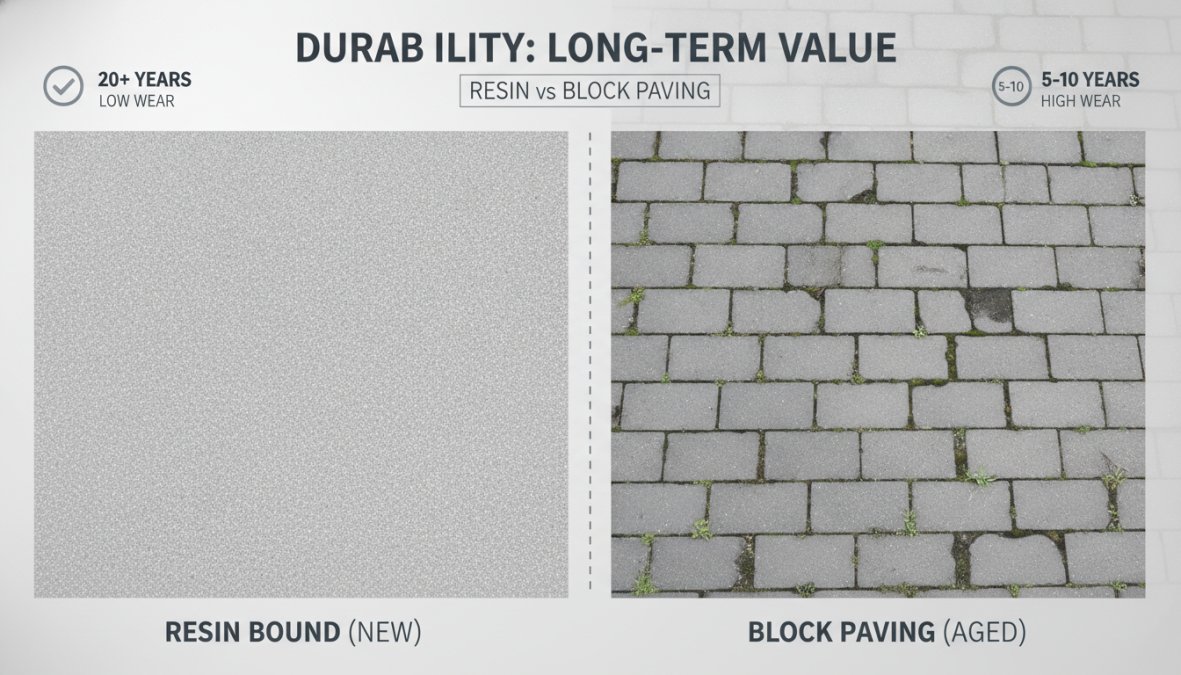
Resin excels in specific durability categories. Its monolithic surface eliminates weed growth entirely, whereas block paving requires regular weeding and joint maintenance. Resin’s permeable nature reduces standing water and drainage issues. SUDS-compliant resin systems drain water through the surface into a sub-base reservoir, supporting sustainable drainage requirements increasingly mandated by local authorities.
Norfolk’s high rainfall and freeze-thaw cycles favour block paving’s robustness, though moisture absorption in joints can cause lifting and subsidence over time, particularly problematic in Norfolk’s clay-heavy soils.
Over 20 years, block paving typically costs 15-20% less in total maintenance and replacement expenses, despite higher initial installation costs.
Resin offers lower upfront investment but demands full replacement mid-lifespan. Block paving requires more active maintenance but delivers superior long-term value.
How to Clean Block Paving and Maintain Both Surfaces
Block paving maintenance requires spring cleaning to assess joint integrity; gaps wider than 5mm indicate settling. Use a pressure washer at 100-150 bar to clean surfaces. Annual joint sealing with polymeric sand (£0.50-1 per square metre) prevents weed germination and stabilises blocks.
Weeds in block paving joints represent the primary maintenance burden. Chemical treatments require reapplication every 6-12 months, while mechanical removal offers a chemical-free alternative. Some homeowners budget £100-200 annually for professional weed control.
Resin bound surfaces require annual pressure washing at 80-100 bar to remove algae and dirt. Small cracks (under 2mm) should be monitored; cracks wider than 3mm warrant professional assessment.
Both surfaces benefit from regular inspection for drainage problems. Pooling water indicates compaction failure or blocked drainage channels. For resin, water should drain through the surface within 5-10 minutes; for block paving, water should disappear from joints similarly. Persistent pooling requires professional remediation, typically £300-600.
Resin maintenance costs average £150-300 annually for professional cleaning, while block paving maintenance runs £200-400 annually when including preventive treatments.
Neglecting block paving joint maintenance for 3+ years creates subsidence and weed problems costing £1,500-3,000 to correct. Ignoring resin surface cracks allows water penetration into the sub-base, leading to complete failure within 1-2 years.
Planning Permission and Installation Process Differences
Block paving installation requires 5-7 days for a standard driveway, including excavation, sub-base preparation (150-200mm compacted crushed stone), laying, and jointing. Weather delays are minimal since block paving proceeds regardless of light rain.
Resin bound installation compresses into 3-5 days but demands precise weather conditions. Temperature must remain above 10°C and ideally below 25°C during application. Rain within 24 hours of installation can compromise the binder, forcing rescheduling.
Block paving typically qualifies as permitted development when replacing an existing driveway. Resin bound paving similarly qualifies in most cases, but permeable paving installations may trigger drainage assessment requirements in flood-risk areas or conservation areas.
New driveways in England must incorporate SUDS-compliant surfaces where feasible. Resin bound paving naturally meets SUDS requirements through its permeable design. Block paving requires either permeable block types or underground drainage systems, adding £800-1,500 if retrofitting drainage infrastructure.
Block paving suits properties with straightforward access and homeowners comfortable with regular joint maintenance. Resin works better for properties requiring SUDS compliance or those prioritising minimal weed management.
Regional Labour Cost Variance and Hidden Expenses
Labour costs in Norfolk fluctuate based on location, seasonality, and site complexity. Urban Norwich sees higher labour rates (£40-50 per square metre) due to congested site access. Suburban areas typically cost £35-45 per square metre, while rural Norfolk may negotiate £30-40 per square metre.
Summer months see peak demand and premium pricing. Spring and autumn offer moderate pricing with reasonable scheduling flexibility. Winter presents the lowest rates, but weather delays frequently extend project timelines.
Hidden expenses emerge frequently. Existing driveway removal costs £5-10 per square metre. Asbestos-containing materials require specialist removal at £20-40 per square metre. Drainage correction adds £800-2,000 depending on severity. Kerb work costs £15-25 per linear metre, often adding £300-600 to projects.
Budget 10-15% contingency (£200-500 for typical driveways) to accommodate unforeseen discoveries during excavation. Reputable installers provide comprehensive assessments identifying potential complications before work begins, preventing mid-project cost escalations.
Choosing between resin and block paving hinges on aligning material characteristics with your property’s requirements and maintenance capacity. Block paving delivers superior long-term durability, making it economical for homeowners planning to stay beyond 15 years. Resin bound paving offers lower upfront costs and minimal weed management, suiting properties requiring SUDS compliance or those demanding a seamless, contemporary finish.
For Norfolk properties seeking professional guidance, KT Lake Paving and Landscaping provides free estimates and detailed cost breakdowns backed by 30 years of industry experience. As a Brett Approved Premier Installer, the team ensures every installation meets British Standards and includes a 10-year product guarantee. Contact KT Lake Paving and Landscaping today for a no-obligation consultation.
Frequently Asked Questions
Is resin driveway cheaper than block paving?
Resin bound typically costs £40-£80 per square metre installed, while block paving ranges from £35-£75 per square metre. However, total resin vs block paving cost depends on sub-base requirements, site conditions, and regional labor rates. Resin often appears cheaper upfront but requires proper sub-base preparation. Block paving may need more long-term maintenance, affecting total cost of ownership over 10-15 years.
What are the main disadvantages of resin driveways?
Key drawbacks include UV stability concerns (yellowing over time without quality resin), potential surface cracking under heavy subsidence, limited repairability (damaged sections require full resin depth replacement), and strict application conditions (weather-dependent installation). Resin bound also requires professional installation to meet British Standards, increasing upfront investment compared to some DIY block paving options.
How long do block paving driveways last compared to resin?
Block paving typically lasts 15-25 years with proper maintenance, including regular weeding and joint re-sanding. Resin bound driveways last 10-15 years under normal use, though quality UV-stable resin can extend this. Block paving's longevity depends on weed resistance and sub-base stability, while resin durability is affected by climate, UV exposure, and installation quality. Both require maintenance to maximize lifespan.
Do I need planning permission for resin or block paving?
Most driveway resurfacing in the UK doesn't require planning permission if you're replacing existing surfaces. However, new permeable paving (resin bound or block paving) may need approval under SUDS (Sustainable Drainage Systems) regulations, particularly in flood-risk areas. Check with your local Norfolk planning authority before installation. SUDS-compliant surfaces improve drainage and may affect your choice between resin and block paving options.


