

Table of Contents
- Tar and Chip vs Gravel Driveways: Key Differences at a Glance
- Durability and Lifespan: How Long Each Surface Lasts
- Tar and Chip Driveway Lifespan and Long-Term Performance
- Maintenance Requirements: Tar and Chip vs Gravel
Tar and Chip vs Gravel Driveways: A 2026 Comparison
Last Updated: July 20, 2026
When choosing between tar and chip vs gravel driveways, homeowners in Norfolk face a decision affecting curb appeal and long-term maintenance costs. KT Lake Paving and Landscaping has spent over 30 years helping property owners navigate this choice. The answer depends on your circumstances: both surfaces offer genuine advantages, but they fail in different ways.
Tar and Chip vs Gravel Driveways: Key Differences at a Glance
Tar and chip is a bound surface where stone chips are embedded into liquid asphalt, creating a textured, permeable layer that locks the aggregate in place. Gravel remains loose and unbound; individual stones sit on a compacted base without adhesive, meaning they shift, scatter, and require constant raking and replenishment.
The fundamental difference is binding. One holds its shape; the other doesn’t. Tar and chip driveways typically last 7-10 years before requiring resealing, whilst properly maintained gravel driveways need topping up every 2-3 years.
The real cost comparison isn’t what you pay at installation, it’s what you pay every year after. Many homeowners choose gravel for lower upfront cost, then spend more over a decade replacing scattered stones than they would have spent on tar and chip from the start.
Durability and Lifespan: How Long Each Surface Lasts
Tar and chip driveways hold their own for 7-10 years under normal use, assuming you reseal them every 2-3 years. The bitumen binding gradually oxidises, but the aggregate stays locked in place throughout. After 10 years, you’ll see surface cracking and potential potholes, but the driveway remains usable until replacement.
Gravel driveways begin losing material immediately. Stone chips migrate to the edges under tyre pressure, washout occurs during heavy rain, and freeze-thaw cycles in Norfolk winters push stones upward and outward. A well-maintained gravel drive might last 5-7 years before the base becomes too compromised for raking to fix.
The critical variable for both is base preparation. A poorly compacted sub-base destroys tar and chip within 3-4 years; gravel becomes unusable in 2-3 years.
Freeze-thaw cycles in Norfolk winters are particularly harsh on gravel driveways. Water infiltrates between stones, freezes, expands, and pushes material upward, creating an increasingly uneven surface. Tar and chip resists this because the bitumen seals the surface and prevents water penetration.
Tar and Chip Driveway Lifespan and Long-Term Performance
Tar and chip surfaces degrade predictably. The first 2-3 years see virtually no wear; years 3-7 represent peak performance. By year 7-8, minor cracking appears at stress points.
Resealing at year 3-4 and again at year 6-7 extends lifespan significantly. Each seal coat adds a fresh bitumen layer, restoring flexibility and preventing water infiltration.
Over 15 years, a tar and chip driveway costs more to install but less to maintain annually than gravel. Gravel requires topping every 2-3 years, whilst tar and chip requires sealing every 3 years. The cumulative cost often favours tar and chip, particularly when factoring in labour time spent raking and re-grading gravel.
Maintenance Requirements: Tar and Chip vs Gravel
Tar and chip demands planned, periodic maintenance. Resealing every 3 years is essential; skip it, and the surface hardens, cracks, and fails prematurely. Between seals, tar and chip requires minimal work: occasional raking and prompt pothole filling.
Gravel requires constant attention. Raking after rain is necessary to maintain a level surface. Topping up with fresh stone every 2-3 years is mandatory. In Norfolk’s wet climate, drainage problems develop quickly without proper maintenance.
| Maintenance Task | Tar and Chip | Gravel |
|---|---|---|
| Annual raking/levelling | Minimal (1-2 times) | Frequent (4-6 times) |
| Resealing/topping | Every 3 years | Every 2-3 years |
| Labour time per year | 2-4 hours | 8-12 hours |
Tar and chip’s sealed surface sheds water effectively, preventing muddy conditions that plague gravel driveways in winter.
Tar and chip requires planned, infrequent work; gravel requires constant, reactive work. If you hate raking and don’t want to commit to sealing, tar and chip fails more gracefully.
Appearance, Traction, and Weather Performance
Tar and chip driveways present a distinctive aesthetic: a dark, textured surface with visible stone chips embedded in bitumen. The textured surface provides excellent traction, even when wet, without the slipperiness of smooth asphalt.
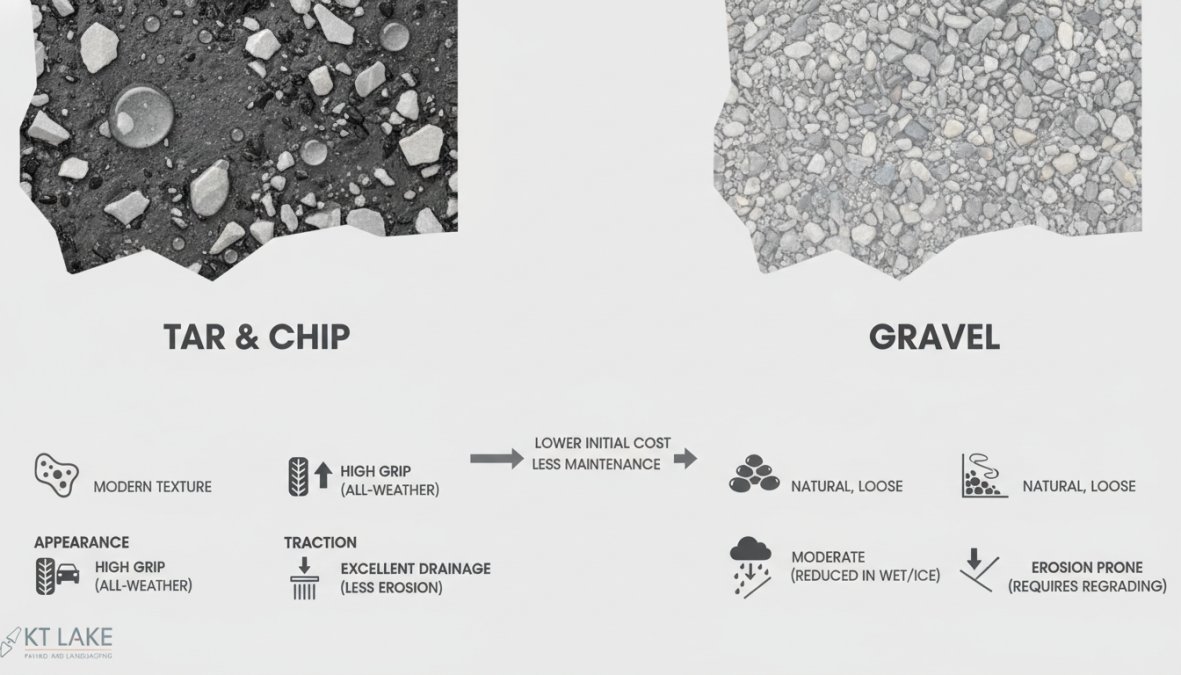
Gravel driveways offer customisable appearance through stone colour and size, but this aesthetic advantage fades as the driveway ages. Traction on gravel varies by stone size and condition; as it compacts, traction decreases and the surface becomes slippery when wet. Tar and chip maintains consistent traction throughout its lifespan.
In Norfolk’s winter conditions, tar and chip outperforms gravel significantly. The sealed surface resists freeze-thaw damage, and snow ploughing is straightforward. Gravel driveways suffer badly: freeze-thaw cycles push stones upward, snow ploughing scatters material, and ice formation creates hazards.
Cost Comparison and Long-Term Value
Installation costs favour gravel: the material is inexpensive, and installation requires only spreading, compacting, and levelling. Tar and chip installation is more labour-intensive and expensive initially.
However, over 15 years, a gravel driveway typically requires 5-6 topping-up cycles plus ongoing raking labour. A tar and chip driveway requires 4-5 resealing cycles and minimal other work. When you add material costs and labour hours, tar and chip often costs less over the long term, despite higher upfront investment.
KT Lake Paving and Landscaping provides free estimates for both tar and chip installation and ongoing maintenance, allowing you to compare exact costs for your specific driveway size and location in Norfolk.
Installation Process and Professional Considerations
Tar and chip installation begins with sub-base preparation: excavation, removal of unsuitable material, and compaction. Proper compaction is critical; this is where many budget installers cut corners, leading to premature failure. Once the base is ready, a prime coat of bitumen is applied, followed by aggregate spreading and compaction. The entire process typically takes 1-2 weeks.
Gravel installation is simpler: the base is compacted, and gravel is spread and levelled. Installation can be completed in 1-2 days, though improper base preparation still compromises longevity.
As a Brett Approved Premier Installer, KT Lake Paving and Landscaping ensures that projects meet rigorous British Standards. This certification means the sub-base, materials, and installation methods are verified to meet industry standards. The 10-year product guarantee from Brett covers defects in materials and workmanship, offering protection that budget installers don’t provide.
Professional installation matters far more than material choice. A poorly installed tar and chip driveway fails early; a well-installed gravel driveway lasts longer than expected.
Choosing between tar and chip vs gravel driveways depends on your priorities: initial cost, long-term durability, maintenance commitment, and climate resilience. In Norfolk, where winters are harsh and rainfall is frequent, tar and chip typically offers better long-term value and performance. KT Lake Paving and Landscaping has guided homeowners through this decision for over 30 years. Request a free, no-obligation estimate to compare costs and timelines for your specific property.
Frequently Asked Questions
Is tar and chip better than gravel for a driveway?
Neither is universally 'better', it depends on your priorities. Tar and chip offers superior durability, better traction in wet or icy conditions, and a more finished appearance. Gravel is more budget-friendly upfront and easier to repair. Tar and chip typically outperforms gravel in freeze-thaw climates and high-traffic areas, whilst gravel suits rural properties or temporary solutions. Consider your local climate, traffic volume, and maintenance tolerance before deciding.
How long do tar and chip driveways last compared to gravel?
Tar and chip driveways typically last 5-7 years with proper maintenance, though some can reach 10 years in favourable conditions. Gravel driveways generally last 2-3 years before requiring significant replenishment. The lifespan of both depends heavily on climate, traffic, and maintenance frequency. In freeze-thaw regions, tar and chip performs better because the bitumen binder resists cracking. Gravel erodes faster, especially under heavy use or poor drainage, requiring regular topping up to maintain a usable surface.
What are the main maintenance differences between tar and chip and gravel driveways?
Tar and chip requires occasional resealing every 2-3 years to refresh the bitumen binder and prevent loose aggregate. Gravel needs frequent raking, levelling, and topping up, sometimes annually in high-traffic areas. Tar and chip is less prone to rutting and potholes but can develop cracks if the sub-base shifts. Gravel requires better drainage management to prevent mud and erosion. Both benefit from prompt pothole repair, but gravel maintenance is more labour-intensive and ongoing, whilst tar and chip maintenance is less frequent but requires professional resealing.
What is the tar and chip driveway installation process?
Installation involves preparing a compacted base layer, applying hot liquid asphalt (bitumen) to the surface, and immediately spreading stone chips (aggregate) across the wet bitumen. The chips embed as the bitumen cools, creating a textured, bonded surface. Proper compaction of the sub-base is critical, poor preparation leads to rutting and premature failure. The process typically takes 1-2 days, depending on driveway size. Professional installation ensures correct bitumen temperature, even chip distribution, and adequate curing time. DIY installation is possible but challenging without specialised equipment.
Can I install or repair tar and chip or gravel driveways myself?
Gravel driveway maintenance is highly DIY-friendly: raking, levelling, and adding fresh aggregate require only basic tools. Minor repairs are straightforward. Tar and chip is more challenging, resealing requires heating bitumen to precise temperatures and even application of stone chips, which demands skill and equipment. Small pothole repairs are manageable, but full resealing is best left to professionals. For gravel, expect annual or biennial maintenance. For tar and chip, professional resealing every 2-3 years ensures longevity, though minor edge repairs and top-up chipping can be tackled by homeowners with care.


