

Table of Contents
- How to Prevent Water Pooling on Resin Driveways: Key Prevention Methods
- Resin Driveway Installation Best Practices to Avoid Pooling
- Driveway Gradient for Drainage: Getting the Slope Right
- Types of Driveway Drainage Systems for Resin Surfaces
Last Updated: July 25, 2026
Water pooling on resin driveways undermines both aesthetic appeal and structural integrity. Understanding how to prevent it is essential for any homeowner in Norfolk looking to protect their property from long-term damage. At KT Lake Paving and Landscaping, we’ve spent over 30 years helping residents across Norfolk avoid this costly issue through proper installation and maintenance.
How to Prevent Water Pooling on Resin Driveways: Key Prevention Methods
Resin-bound driveways are naturally permeable surfaces, meaning water should drain through the material into the sub-base below rather than sitting on top. Pooling typically occurs because the sub-base has compacted, the gradient is insufficient, or the drainage system isn’t functioning properly.
Prevention starts during installation. A properly constructed resin driveway includes a well-compacted sub-base with adequate void space, a correct slope away from structures, and a permeability rate that exceeds UK Building Regulations requirements. The sub-base is more critical than the resin layer itself, a weak foundation will fail regardless of surface quality.
A common mistake is assuming that because resin is permeable, any gradient will work. You need at least a 1:40 slope (2.5%) to ensure water moves consistently toward drainage points. Anything less will cause water to linger, especially after heavy rain.
Resin Driveway Installation Best Practices to Avoid Pooling
Installation quality determines whether your driveway will shed water effectively or trap it. A properly prepared sub-base should be compacted in layers, typically 150-200mm deep. MOT Type 1 or similar angular aggregate allows water to percolate downward whilst maintaining structural stability. Round stone or poor-quality materials compact too tightly and reduce permeability.
The resin layer should be applied at the correct thickness, typically 18-20mm for resin-bound surfaces. Proper installation also includes edge details that direct water toward designated drainage zones rather than toward your property foundations. A designated soakaway or drainage outlet is essential, without it, even a perfectly sloped driveway will eventually develop pooling.
A sub-base that isn’t properly compacted will settle over time, destroying the gradient you paid for. Settlement of just 10-15mm can eliminate slope and create pooling within 2-3 years. This is why Brett Approved installers like KT Lake Paving and Landscaping use specific compaction standards and equipment.
Driveway Gradient for Drainage: Getting the Slope Right
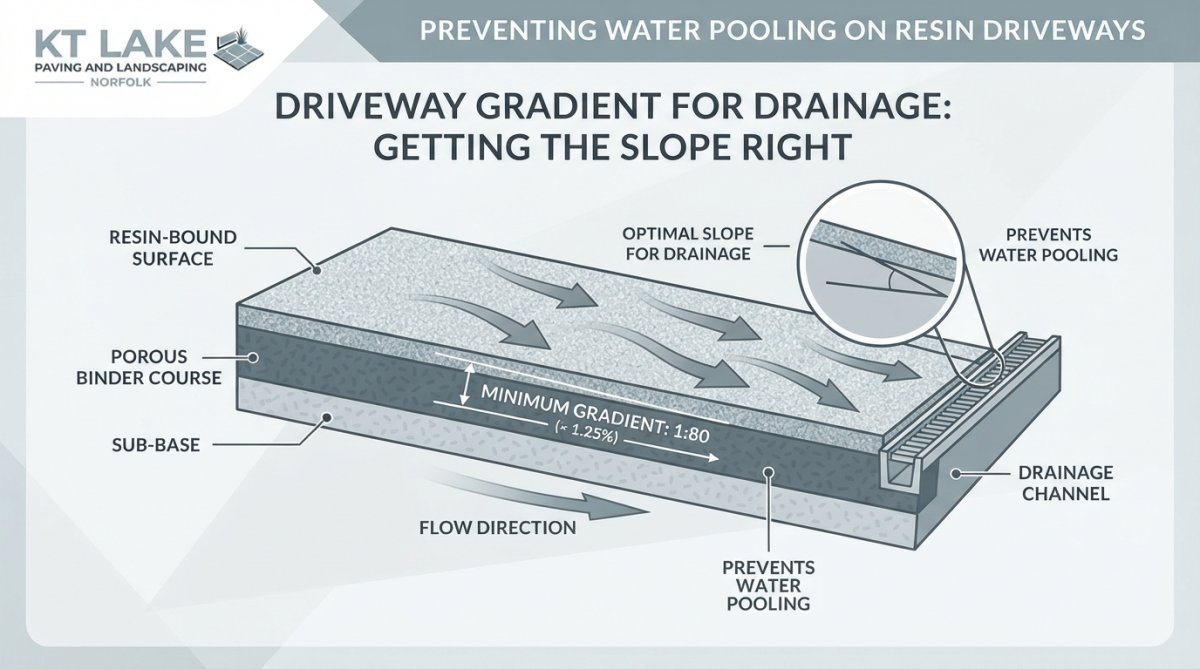
The gradient is where many homeowners and installers make critical mistakes. The minimum recommended gradient for preventing water pooling on resin driveways is 1:40 (2.5%), which means for every 40 units of horizontal distance, the surface drops 1 unit vertically. For a typical 5-metre driveway, this translates to a 125mm height difference from one end to the other. In Norfolk, where rainfall can be heavy and sustained, a steeper gradient of 1:30 (3.3%) is often preferable.
| Gradient Ratio | Drop per 5m | Suitability | Typical Outcome |
|---|---|---|---|
| 1:60 (1.7%) | 83mm | Not recommended | Pooling likely |
| 1:40 (2.5%) | 125mm | Minimum acceptable | Adequate drainage |
| 1:30 (3.3%) | 167mm | Preferred | Reliable drainage |
| 1:20 (5%) | 250mm | Steep but effective | Excellent drainage |
The gradient should direct water toward a drainage point, either a soakaway, a permeable edge, or a surface water drain connected to the mains system.
The most common mistake is underestimating how much slope you actually need. A driveway that looks “good enough” visually often has insufficient gradient to handle sustained rainfall, especially in autumn and winter.
Types of Driveway Drainage Systems for Resin Surfaces
Effective drainage systems come in several forms, and the best choice depends on your property’s location, soil conditions, and local water table.
Soakaway systems are the most common solution for residential driveways. A soakaway is a pit filled with permeable material that allows water to percolate slowly into the ground. For a typical residential driveway, a soakaway should be at least 1 metre cubed and positioned at the lowest point of the slope.
Permeable edge drainage directs water off the driveway’s edges into a gravel trench or permeable border. This works well for driveways with adequate side space and is particularly effective in Norfolk where groundwater levels allow for lateral drainage.
Mains surface water drainage connects the driveway to the public surface water system via a pipe. This requires planning permission in many cases and must comply with Building Regulations, but it’s the most reliable option for properties in areas with poor natural drainage or high water tables. According to UK Building Regulations guidance on surface water management, properties in flood-risk areas should prioritise mains drainage where available.
Hybrid systems combine multiple drainage methods, ensuring that if one drainage route becomes blocked, water still has an alternative path.
Maintenance Tips for Resin Driveways
Even a perfectly installed driveway will develop pooling if maintenance is neglected. Clear debris from the driveway surface regularly, especially after autumn leaf fall. Leaves and moss can block the pores of the resin, reducing permeability.
Inspect the gradient annually by observing how water behaves during and after rain. Check soakaway systems every 2-3 years to ensure they’re not blocked, as a blocked soakaway is a common cause of sudden pooling. Avoid using salt or harsh de-icing chemicals in winter, grit-based de-icers are safer and won’t compromise drainage. Never apply sealants or coatings that claim to "waterproof" the surface; resin driveways must remain permeable to function properly.
Troubleshooting Existing Pooling Problems
If your resin driveway already shows signs of pooling, the solution depends on the cause.
Pooling caused by poor gradient can sometimes be addressed by improving the drainage outlet rather than re-laying the entire surface. Adding a second soakaway or installing a permeable edge drain can redistribute water more effectively.
Pooling caused by sub-base settlement is more serious. If the sub-base has compacted significantly, the gradient has been lost and surface-level solutions won’t help. Depending on the extent of settlement, you may need to re-level sections of the driveway or, in severe cases, remove and re-lay the affected area.
Pooling caused by a blocked soakaway is often the easiest to fix. If the soakaway is clogged with silt or debris, it can sometimes be excavated and refilled. However, if the soakaway was poorly constructed or inadequately sized from the start, replacement may be necessary.
Water pooling on resin driveways is preventable through proper installation, correct gradient design, and appropriate drainage systems. KT Lake Paving and Landscaping brings over 30 years of experience in Norfolk driveway installation, with Brett Approved Premier Installer status and a 10-year product guarantee backing every project. Our team assesses site conditions, designs drainage systems tailored to your property, and ensures installation meets or exceeds British Standards. Get a free, no-obligation consultation to evaluate your driveway’s drainage needs and discover how proper planning eliminates pooling problems before they start.
Frequently Asked Questions
Why is water pooling on my resin driveway if it's supposed to be permeable?
Water pooling on resin driveways typically results from improper sub-base installation, inadequate gradient, or compacted aggregate reducing void space. Even permeable resin-bound surfaces depend on a well-constructed foundation with proper porosity and drainage channels. If the sub-base lacks adequate depth or uses poor-quality materials, water cannot permeate effectively, causing surface pooling. Additionally, if the driveway gradient is too shallow, water won't flow towards drainage points regardless of the resin's permeability rating.
What's the difference between resin-bound and resin-bonded for drainage performance?
Resin-bound driveways are fully permeable throughout, aggregate is mixed into the resin, creating void space for water infiltration and groundwater recharge. Resin-bonded surfaces apply resin over existing aggregate, creating a sealed top layer that's less permeable. For preventing water pooling, resin-bound is superior because water passes through the entire depth, reducing surface runoff and hydrostatic pressure on foundations. Resin-bonded works better as a decorative overlay on existing stable surfaces.
How often should I maintain my resin driveway to prevent pooling issues?
Inspect your resin bound driveway quarterly for debris, moss, or algae buildup that can block pores and reduce permeability. Clean with a soft-bristled brush and mild detergent every 6-12 months, depending on climate and foot traffic. In wet UK climates, more frequent cleaning prevents organic growth that compromises drainage. Check for cracks or subsidence annually, these allow water to pool beneath the surface rather than draining through the sub-base. Early maintenance prevents costly repairs and maintains optimal drainage performance.
Do I need planning permission for a permeable resin driveway under UK SuDS regulations?
Most residential resin driveways don't require planning permission, but they must comply with Building Regulations Part H (Drainage and Waste) and Sustainable Drainage Systems (SuDS) standards. If your driveway exceeds 5 square metres and connects to mains drainage, SuDS approval may be needed. Permeable resin-bound surfaces satisfy SuDS requirements because they reduce surface water runoff and support groundwater recharge. Check with your local planning authority before installation, regulations vary by region. Professional installers like KT Lake Paving ensure compliance with British Standards.


