

Table of Contents
- Is Professional Driveway Resurfacing Worth It? The ROI Perspective
- Driveway Resurfacing vs Replacement: Which Offers Better Value
- Signs Your Driveway Needs Resurfacing: Timing Matters
- How Long Does Driveway Resurfacing Last? Durability Expectations
Last Updated: July 9, 2026
Is Professional Driveway Resurfacing Worth It? The ROI Perspective
When homeowners notice their asphalt cracking, fading, or developing potholes, they ask whether professional driveway resurfacing makes financial sense. The answer depends on your driveway’s current condition, budget, and how long you plan to stay in your home. Professional resurfacing typically costs significantly less than replacement while extending pavement life by 7-10 years. Beyond cost, the real value lies in protecting structural integrity and curb appeal. A deteriorating driveway affects buyer perception, can lead to foundation damage from water penetration, and creates safety hazards. Research from the National Asphalt Pavement Association shows that preventative maintenance like resurfacing extends pavement lifespan significantly compared to deferred repairs.
The best time to resurface is BEFORE you see alligator cracking or potholes. Catching surface damage early costs 40-50% less than waiting until structural failure requires replacement.
Driveway Resurfacing vs Replacement: Which Offers Better Value
Choosing between resurfacing and replacement hinges on structural damage. Resurfacing applies a fresh layer over the existing base to address surface-level deterioration, cracks, and minor potholes. Replacement removes the entire driveway and rebuilds from the foundation up, necessary only when the base layer has failed.
Resurfacing typically costs roughly half what replacement does, but only works if your driveway’s foundation is sound. If water has penetrated the base layer and caused it to shift or crumble, resurfacing will fail within 2-3 years.
| Condition | Best Option | Why | Typical Durability |
|---|---|---|---|
| Surface cracks, minor discoloration, intact base | Resurfacing | Addresses visible wear without structural work | 7-10 years |
| Alligator cracking, 2-3 small potholes, stable base | Resurfacing | Still cost-effective if base hasn’t failed | 7-10 years |
| Large potholes, base failure, extensive cracking | Replacement | Resurfacing won’t hold; base is compromised | 15-20 years |
| Severe structural failure, drainage issues | Replacement | Water damage and settling require complete rebuild | 15-20 years |
Professional contractors offer free inspections to determine which option applies. They’ll examine whether water is pooling, check for soft spots indicating base failure, and assess overall structural integrity.
Applying new asphalt over a failed base wastes money and delays the real solution. The fresh surface will crack within months as the unstable foundation continues to shift.
Signs Your Driveway Needs Resurfacing: Timing Matters
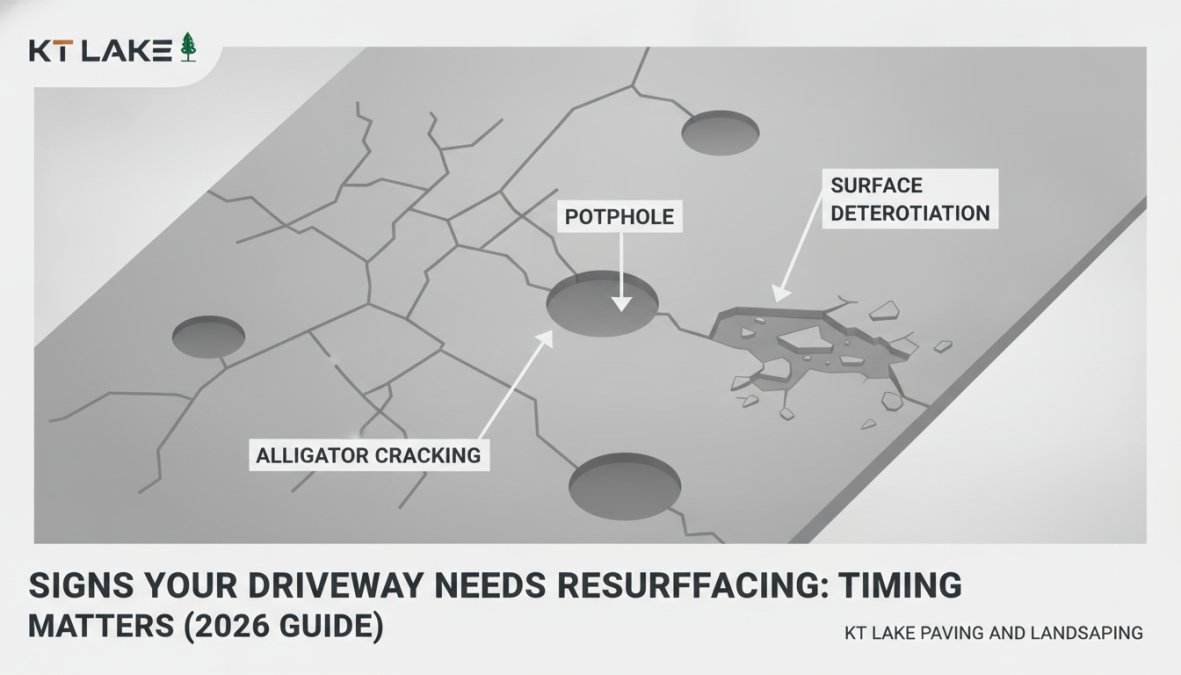
Catching driveway damage early is where resurfacing delivers the most value. The longer you wait, the more likely surface problems will penetrate to the base layer, forcing expensive replacement.
Alligator cracking appears as a web-like pattern resembling alligator skin, signaling that the asphalt binder is breaking down. Catching this in early stages, before spalling begins, is ideal for resurfacing.
Fading and oxidation indicate the asphalt’s protective oils are depleting, making it more brittle. While cosmetic initially, fading that progresses to visible cracking makes resurfacing the better investment than sealcoating alone.
Small potholes and surface spalling show water has penetrated the asphalt. One or two small potholes can be patched, but repeated repairs signal resurfacing is needed. Norfolk’s freeze-thaw cycles accelerate pothole formation as water enters cracks, freezes, expands, and breaks apart asphalt.
Soft or spongy spots indicate base failure. If the driveway feels like it flexes underfoot, resurfacing alone won’t help, replacement is necessary.
Drainage problems where water pools suggest the driveway has settled or the sub-base has shifted, indicating structural issues resurfacing can’t fix.
The best time for resurfacing is when you see early-stage cracking but the driveway still feels solid. Acting at this point typically extends your driveway’s life another 7-10 years.
How Long Does Driveway Resurfacing Last? Durability Expectations
Professional driveway resurfacing typically lasts 7-10 years, though this varies based on climate, traffic volume, and maintenance. In Norfolk’s freeze-thaw climate, regular sealcoating extends durability toward the longer end of that range.
Most asphalt resurfacing requires 24-48 hours of curing before normal driving. Driving too early or exposing fresh asphalt to heavy rain before curing can compromise the bond and shorten lifespan.
Material choice matters significantly. Traditional hot-mix asphalt is standard, while resin-bound and hot tar and chip surfacing offer enhanced durability and often extend lifespan to 10-12 years with superior UV and weathering resistance.
Sealcoating frequency is the single biggest factor you control. Applying sealcoat every 2-3 years protects asphalt from oxidation, water penetration, and UV damage. Driveways receiving regular sealcoating last 10+ years; those without often fail at 6-7 years.
Drainage and grading affect water interaction with pavement. Proper slope and drainage keep surfaces drier and extend lifespan by 2-3 years compared to poor drainage.
Traffic volume and vehicle weight influence durability. Residential driveways experience far less stress than commercial lots with delivery trucks.
Climate stress from freeze-thaw cycles, extreme heat, and salt exposure shortens lifespan. Norfolk’s winters create annual freeze-thaw stress that cracks asphalt if the base isn’t properly maintained.
The difference between a 6-year and 10-year resurfaced driveway often comes down to sealcoating. Spend $300-500 every 2-3 years and your investment pays dividends in extended lifespan.
A resurfaced driveway lasting 8-10 years costs roughly half what replacement does. After 10 years, you can resurface again for another 8-10 years of life. For most homeowners, the resurfacing-every-decade approach is more financially flexible than replacement-once-per-20-years.
For most Norfolk homeowners with early-to-moderate driveway damage, professional resurfacing is worth the investment. It protects your property’s foundation, improves curb appeal, and costs a fraction of replacement while delivering 7-10 years of durability. The key is timing, addressing damage before it reaches the base layer ensures resurfacing solves the problem rather than delays it. KT Lake Paving and Landscaping offers free inspections to assess your driveway’s condition and recommend the right solution. With over 30 years of experience and a 10-year product guarantee, they can help you understand exactly what your driveway needs and what it will cost to protect your investment.
Frequently Asked Questions
Is professional driveway resurfacing worth it compared to replacement?
Professional driveway resurfacing is often worth it when your pavement shows surface damage but has sound structural integrity. Resurfacing costs significantly less than full replacement and can extend your driveway's longevity by 7-10 years when performed by a professional contractor. The decision depends on your driveway's base condition, age, and climate. If the sub-base is failing or damage is severe, replacement may be more cost-effective long-term. A professional assessment determines which option delivers better ROI for your specific situation.
How long does professional driveway resurfacing last?
Professional driveway resurfacing typically lasts 7-10 years, depending on material type, climate conditions, and maintenance. In areas with harsh freeze-thaw cycles, durability may be shorter. Concrete resurfacing generally outlasts asphalt in extreme climates. Regular sealcoating and proper drainage maintenance can extend the life of your resurfaced driveway. Norfolk's maritime climate requires attention to moisture management to maximize longevity. Professional installation ensures proper curing time and material application, which directly impacts how long your resurfaced driveway will perform.
What's the difference between driveway resurfacing and replacement?
Resurfacing applies a new wearing layer over an existing, structurally sound base, preserving the sub-base and reducing labor costs. Replacement removes the entire pavement system and installs new asphalt or concrete from the ground up. Resurfacing is more cost-effective for surface damage like alligator cracking and potholes, while replacement is necessary when base failure or severe structural damage exists. Resurfacing typically takes less time and disrupts your property less. However, if your driveway's foundation is compromised, resurfacing won't address underlying issues, making replacement the better long-term investment.
Does professional driveway resurfacing increase home value?
Yes, professional driveway resurfacing enhances curb appeal and can positively impact home value perception. A well-maintained driveway signals property care to potential buyers and improves first impressions. However, resurfacing typically returns 50-80% of its cost in home value, not dollar-for-dollar. The ROI depends on your local market, property condition, and material choice. In Norfolk's competitive property market, investing in professional resurfacing with quality materials and proper sealcoating can strengthen your home's aesthetic value and appeal to buyers concerned about structural integrity.


