

Table of Contents
- Why Homeowners Are Choosing Alternatives to Traditional Concrete Driveways
- Permeable Driveway Pavers: Modern Design Meets Function
- Cost of Gravel Driveway Installation: Budget-Friendly Basics
- Asphalt vs. Concrete Driveway Maintenance: Durability Comparison
Last Updated: July 10, 2026
When homeowners in Norfolk consider replacing their driveways, concrete often feels like the default choice. Today, alternatives offer superior durability, environmental benefits, and aesthetic flexibility that rival, and often exceed, what poured concrete delivers. This guide explores the most practical options available in 2026, helping you make an informed decision based on your climate, budget, and maintenance tolerance.
The best driveway material depends on three factors: your local climate (especially freeze-thaw severity), vehicle load capacity needed, and how much maintenance you’re willing to perform annually. Climate suitability matters more than cost alone.
Why Homeowners Are Choosing Alternatives to Traditional Concrete Driveways
Concrete driveways face significant drawbacks. Freeze-thaw cycles in Norfolk winters cause cracking and spalling. Concrete absorbs salt and de-icing chemicals, accelerating deterioration. The material is rigid, meaning ground movement creates permanent cracks that spread over time.
Environmental concerns also drive the shift. Concrete production generates roughly 8% of global CO2 emissions. Homeowners increasingly prefer permeable solutions that reduce stormwater runoff and support sustainable drainage systems (SUDS) compliance, increasingly mandatory in local planning regulations. Aesthetically, concrete offers limited customization, while modern alternatives deliver visual warmth, color variety, and design flexibility that enhance curb appeal.
Permeable Driveway Pavers: Modern Design Meets Function
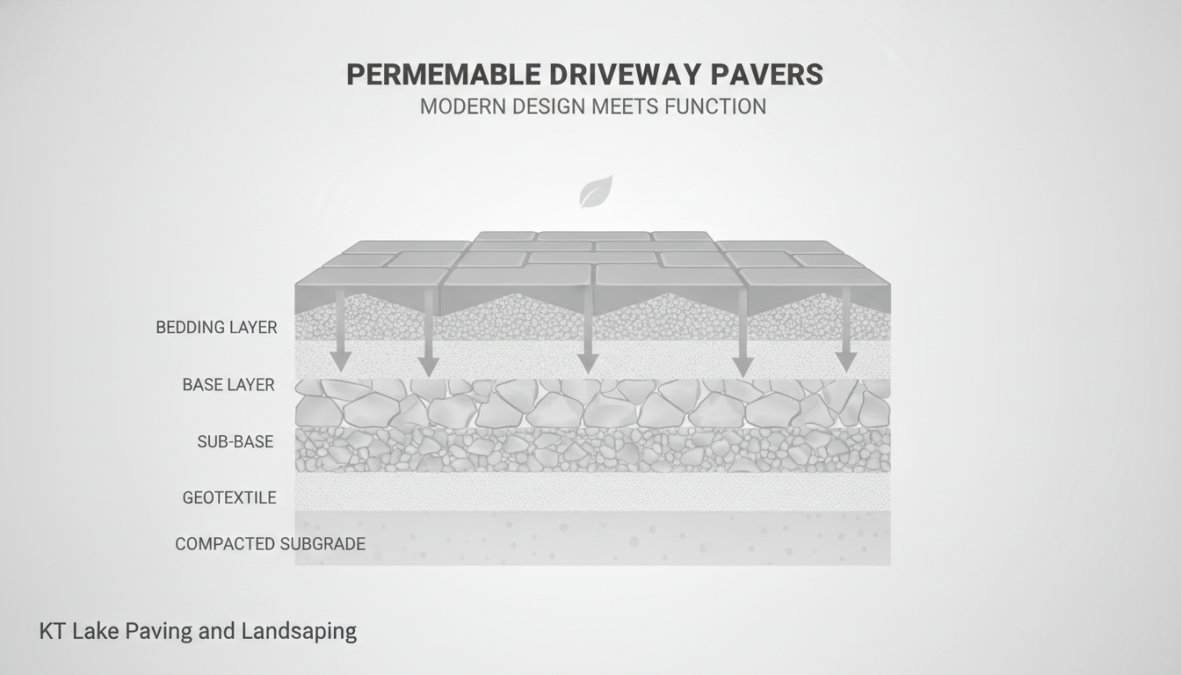
Permeable pavers represent the most popular alternative to traditional concrete driveways. These interlocking systems allow water to infiltrate through the surface into a prepared sub-base, eliminating surface pooling and reducing flooding risk.
Structural integrity depends entirely on proper sub-base preparation. A compacted foundation of crushed stone and geogrid ensures even load distribution and prevents rutting. Interlocking concrete pavers like Belgard Permeable Pavers offer traditional aesthetics with modern environmental benefits. Plastic grid systems like TRUEGRID and EcoGrid are filled with gravel or grass, creating a reinforced surface that prevents potholes while maintaining full permeability.
| Permeable Paver Type | Load-Bearing Capacity | Installation Complexity | Maintenance Frequency | Best For |
|---|---|---|---|---|
| Concrete pavers (Belgard, Marshalls Priora) | Heavy vehicles | Moderate | Annual sealing | Traditional aesthetics with drainage |
| Plastic grids (TRUEGRID, EcoGrid, IBRAN) | Heavy vehicles | Low | Minimal | Budget-conscious, DIY-friendly installations |
| Resin-bound (Addagrip, Rockpave) | Standard vehicles | High (professional only) | Annual cleaning | Modern finish, premium appearance |
Installation typically takes 5-7 days for a standard residential driveway. Sub-base preparation accounts for 60% of the work.
Permeable pavers fail when sub-base preparation is rushed. Inadequate compaction causes uneven settling within 2-3 years, creating trip hazards and water pooling. Professional installation is essential for long-term performance.
Cost of Gravel Driveway Installation: Budget-Friendly Basics
Gravel driveways remain the most affordable alternative to traditional concrete. However, loose gravel’s primary weakness is migration, vehicle tires displace stones within 12-18 months.
Gravel stabilization systems solve this by containing stones within a honeycomb structure. CORE Foundations gravel grids prevent displacement while remaining virtually invisible once filled, creating a stable, permeable surface that looks like traditional gravel but performs like engineered pavement. Installation is straightforward: excavate 150mm, compact the base, lay the stabilization grid, and fill with aggregate. Over ten years, stabilized systems cost 30-40% less than regular gravel despite higher initial investment, as they require only occasional raking versus annual maintenance for unstabilized gravel.
Stabilized gravel driveways suit rural Norfolk properties, secondary access routes, or homeowners preferring natural aesthetics. They’re unsuitable for steep slopes or heavy commercial traffic.
Asphalt vs. Concrete Driveway Maintenance: Durability Comparison
Asphalt and concrete represent the two mainstream hard-surface options with dramatically different maintenance profiles.
Asphalt driveways typically last 12-15 years in Norfolk’s climate due to salt exposure and freeze-thaw cycles. Concrete lasts 25-30 years under ideal conditions, but cracks develop faster in regions with temperature fluctuation. Asphalt requires seal-coating every 2-3 years at roughly £0.50-£1.00 per square meter. Concrete requires minimal maintenance initially but becomes expensive once cracking begins, as cracks cannot be sealed permanently.
For Norfolk, asphalt performs better than concrete in winter due to its flexibility. However, asphalt demands consistent maintenance discipline. The cost comparison depends on maintenance commitment: concrete has low maintenance first 10 years then escalating repair costs, while asphalt has consistent maintenance costs spread across its lifespan.
Eco-Friendly Alternatives: Sustainable Driveway Solutions
Environmental consciousness drives many homeowners toward alternatives to traditional concrete driveways. Permeable pavers excel environmentally by supporting SUDS compliance, reducing strain on municipal drainage and preventing flash flooding. Stormwater infiltration recharges groundwater aquifers instead of running off into streams.
Recycled materials feature prominently in modern alternatives. Plastic grids use 100% post-consumer recycled HDPE, diverting waste from landfills. Recycled asphalt (RAP) reuses material from old road surfaces. Resin-bound surfaces can incorporate recycled aggregate and require no seal-coating cycles, meaning reduced maintenance and lower overall environmental impact than asphalt over 20 years.
The most sustainable choice depends on context. For Norfolk, climate suitability matters most, a sustainable material that fails wastes resources faster than a less eco-friendly option that lasts.
Driveway Materials Comparison Table
| Material | Lifespan (Norfolk Climate) | Maintenance Frequency | Permeability | Upfront Cost | Best For |
|---|---|---|---|---|---|
| Concrete | 15-20 years | Minimal initially, high repair costs later | No | Moderate | Homeowners accepting long-term repair investment |
| Asphalt | 12-15 years | Seal-coat every 2-3 years | No | Moderate | Owners committed to regular maintenance |
| Permeable pavers | 20-25 years | Annual cleaning, occasional joint weeding | Yes | High | Premium aesthetics + SUDS compliance |
| Stabilized gravel | 10-15 years | Annual raking, aggregate top-ups | Yes | Low | Rural properties, secondary access |
| Resin-bound | 15-20 years | Annual cleaning | Yes | High | Modern finish, minimal maintenance |
Choosing the Right Alternative for Your Norfolk Property
Selecting alternatives to traditional concrete driveways requires matching material properties to local climate patterns, vehicle loading, and personal maintenance tolerance.
Norfolk’s climate presents distinct challenges: winter temperatures fluctuate around freezing, coastal properties face salt spray exposure, and rainfall is moderate but concentrated in winter. These conditions favor permeable systems and asphalt that flexes with temperature change. Vehicle loading matters practically, a family car exerts 500-700 kg per wheel; an SUV approaches 1,000 kg. Permeable pavers and stabilized gravel handle standard residential loads easily.
For most Norfolk homeowners, permeable pavers represent the best balance: durable, aesthetically flexible, environmentally responsible, and requiring modest maintenance. KT Lake Paving and Landscaping specializes in resin-bound and hot tar and chip surfacing, both excellent alternatives delivering professional results with minimal long-term maintenance.
Choosing the right driveway surface is one of the most impactful decisions for your Norfolk property. Alternatives to traditional concrete driveways now offer superior durability, environmental performance, and visual appeal. KT Lake Paving and Landscaping offers free, no-obligation consultations and expert guidance tailored to Norfolk’s specific climate and local regulations.
British Standards for permeable paving systems
Sustainable Drainage Systems (SUDS) guidance for homeowners
Environmental impact of concrete production and alternatives
Frequently Asked Questions
What is the cheapest alternative to a concrete driveway?
Crushed stone and gravel driveways are typically the most budget-friendly alternatives to traditional concrete driveways. However, they require more frequent maintenance, including regular raking and compaction to prevent rutting and erosion. Recycled plastic gravel grids can stabilise loose stone and extend lifespan. For current pricing on budget-friendly alternatives, KT Lake Paving and Landscaping offers free estimates tailored to your property.
Are permeable driveway pavers better for drainage and stormwater management?
Yes, permeable driveway pavers are specifically engineered to reduce stormwater runoff by allowing water to infiltrate through the joints into a calculated sub-base. This makes them compliant with sustainable drainage systems (SUDS) and can reduce flood risk. They also help manage the heat island effect better than solid concrete. Installation requires proper geogrid and aggregate sub-base design to ensure long-term structural integrity and drainage performance.
Which driveway material requires the least maintenance?
Resin-bound surfaces and permeable concrete pavers generally require the least maintenance compared to gravel or asphalt. Resin-bound finishes are weed-resistant and slip-resistant, needing only occasional cleaning. Permeable pavers avoid the rutting issues of loose gravel and resist cracking better than poured concrete. Asphalt requires regular resurfacing every 15-20 years, while concrete may need repair after 20-30 years depending on climate and load-bearing demands.
Can I install a driveway alternative myself, or do I need a professional contractor?
Some alternatives like recycled plastic gravel grids are DIY-friendly and require minimal tools, though proper sub-base preparation is critical to prevent shifting. Resin-bound surfaces, however, require professional installation for a high-quality, uniform finish. Permeable pavers demand precise compaction, geogrid placement, and drainage design. Poor installation is a real-world failure mode that compromises durability. KT Lake Paving and Landscaping, as a Brett Approved Premier Installer, ensures workmanship meets British Standards with a 10-year guarantee.


