

Table of Contents
- Signs of Poor Driveway Sub-Base: 7 Warning Indicators
- Driveway Sub-Base Depth Requirements and Standards
- How to Repair Driveway Base Failure: Assessment and Solutions
- Best Materials for Driveway Sub-Base: Durability and Performance
Last Updated: June 27, 2026
Signs of Poor Driveway Sub-Base: 7 Warning Indicators
A driveway’s sub-base, the foundation layer beneath asphalt or concrete, bears the weight of vehicles and weather stress. When it fails, problems compound quickly. Recognizing these signs early can save thousands in repair costs. At KT Lake Paving and Landscaping, we’ve spent over 30 years identifying foundation issues before they become catastrophic.
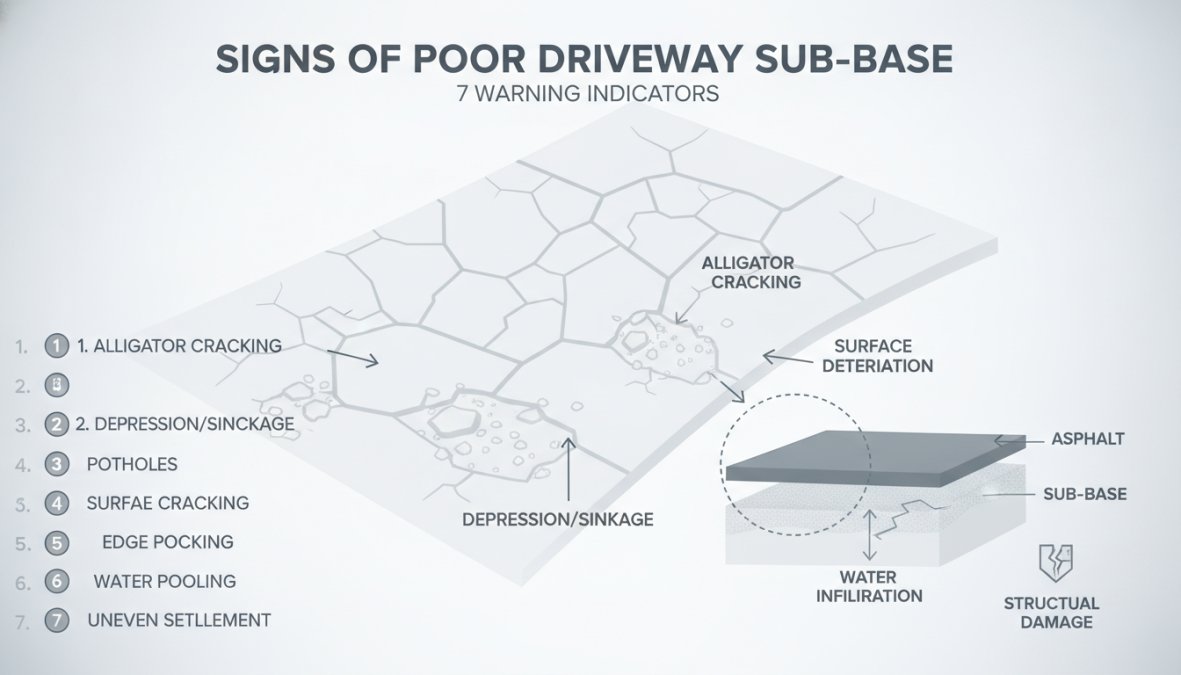
1. Alligator Cracking Across the Surface
Alligator cracking, a web-like pattern resembling an alligator’s skin, signals sub-base failure. The cracks form when the foundation shifts unevenly, forcing the asphalt to flex and fracture. Water seeps through these cracks, accelerating deterioration.
Alligator cracking covering more than 25% of your driveway surface means structural failure is imminent. Ignoring it leads to potholes and complete pavement collapse within months.
2. Potholes and Sunken Sections
Potholes form when water penetrates the sub-base, weakening soil and stone layers. Sunken sections indicate the sub-base has compacted unevenly or washed away. Each pothole represents a structural weakness that expands with every vehicle passing over it.
3. Soft or Spongy Pavement
If certain areas feel soft or bounce slightly underfoot, the sub-base has become saturated or lost structural integrity. The base materials have either washed away or failed to compact properly. This is one of the earliest warning signs before visible cracking appears.
Press firmly on the driveway surface with your foot. If it yields noticeably, the sub-base is compromised and needs professional assessment.
4. Lateral Displacement or Bulging
When the sub-base shifts sideways, the asphalt buckles outward, creating visible humps. This indicates complete foundation failure in that section and requires full-depth excavation to repair.
5. Standing Water or Drainage Issues
Puddles that linger after rain signal poor sub-base drainage. A properly constructed sub-base allows water to drain away. Standing water accelerates all failure modes by weakening soil and promoting cracking.
6. Edge Cracking and Deterioration
Cracks along driveway edges indicate the sub-base is eroding at the perimeter as water washes away supporting soil. This spreads inward, eventually undermining the entire pavement.
Edge cracking is preventable with proper grading and drainage. Address it immediately before it spreads to the center of the driveway.
7. Rapid Deterioration After Repair
If patched areas fail again within months, the sub-base is the culprit. Surface repairs can’t fix foundation problems. This pattern indicates the underlying foundation is unstable.
Driveway Sub-Base Depth Requirements and Standards
For residential driveways in Norfolk, the standard is 4 to 6 inches of compacted gravel or recycled asphalt, depending on soil conditions. Commercial parking lots require 6 to 8 inches or more to handle heavy-duty loads. Depth must account for soil bearing capacity and freeze-thaw cycles.
According to Virginia Department of Transportation pavement design guidelines, proper sub-base preparation is essential for pavement longevity. Many property managers underestimate requirements, thinking a thin layer will suffice. A properly engineered sub-base costs more upfront but extends pavement life by 10+ years.
Residential driveways with moderate traffic typically need 4-inch sub-bases. Commercial properties and areas with poor drainage should go to 6 inches or deeper.
How to Repair Driveway Base Failure: Assessment and Solutions
Repairing a failed sub-base requires honest assessment of the damage. Not every problem requires complete removal and replacement.
Step 1: Professional Inspection
A thorough inspection by experienced contractors determines whether you need patching, partial excavation, or full-depth reconstruction. Professional assessment costs $200-500 but prevents $5,000+ in wasted repairs.
Step 2: Partial Repair for Localized Failure
If failure is confined to one section, partial excavation and replacement may work. This involves removing damaged asphalt and sub-base materials down to stable soil, then rebuilding with proper compaction. Partial repairs work best when failure is limited and surrounding sub-base remains solid.
Step 3: Full-Depth Excavation and Milling
When sub-base failure extends across most of the driveway, full-depth excavation is necessary. This removes all asphalt and compromised materials, then rebuilds the sub-base with properly graded stone, compacted in layers. This approach ensures pavement lasts 15-20 years with proper maintenance.
Patching a driveway with widespread sub-base failure is temporary. The underlying problem will continue to worsen, wasting money on repeated repairs.
Step 4: Stormwater Management Solutions
Once repaired, proper drainage prevents future failure. Solutions include grading to direct water away, installing French drains if needed, and ensuring sub-base materials allow water to percolate downward. In Norfolk’s humid climate, drainage is critical.
Best Materials for Driveway Sub-Base: Durability and Performance
Crushed Limestone and Stone
Crushed limestone compacts well and provides good drainage for residential driveways. However, it breaks down under heavy commercial traffic and may not provide sufficient load-bearing capacity in clay soils without reinforcement.
Recycled Asphalt Millings
Recycled asphalt is environmentally responsible and compacts tightly. It actually bonds together over time as the binder reactivates, creating a more stable base than virgin stone. Research shows recycled asphalt performs comparably to new materials while reducing environmental impact.
Geotextile Fabric and Stabilization
For poor soil conditions common in Norfolk, geotextile fabric separates the sub-base from unstable soil below. This prevents mixing and maintains base integrity, particularly valuable for industrial roadways and commercial parking lots.
Concrete Sub-Base Layers
A concrete sub-base layer beneath asphalt resists movement and handles extreme loads. It’s expensive and typically reserved for industrial roadways or high-traffic commercial areas.
| Material | Durability | Cost | Best For | Drainage |
|---|---|---|---|---|
| Crushed Limestone | Moderate | Low | Residential, moderate traffic | Good |
| Recycled Asphalt | High | Moderate | Commercial, all traffic levels | Excellent |
| Geotextile + Stone | Very High | Moderate-High | Poor soil conditions | Excellent |
| Concrete Base | Excellent | High | Industrial, extreme loads | Varies |
For Norfolk properties, recycled asphalt combined with proper grading offers the best balance of durability, cost, and environmental responsibility.
Driveway failures develop gradually as the sub-base weakens. Early detection saves money and prevents safety hazards. If you’ve noticed any of these warning signs on your Norfolk property, professional sub-base assessment is your next step. KT Lake Paving and Landscaping offers free inspections and estimates. With over 30 years of experience, we’ve rebuilt hundreds of driveways to last 15+ years with a 10-year product guarantee. Contact us today for a professional assessment.
Frequently Asked Questions
What are the most obvious signs of poor driveway sub-base?
The primary signs of poor driveway sub-base include alligator cracking (interconnected cracks resembling a reptile's skin), sinking or settlement in specific areas, potholes, water pooling, rutting from vehicle weight, and a soft or spongy feel underfoot. These indicate the base layer is failing to provide adequate load-bearing capacity and drainage support for the surface layer above it.
How deep should a driveway sub-base be for proper support?
Driveway sub-base depth requirements typically range from 4 to 8 inches, depending on soil type, climate, and expected traffic load. In Norfolk's humid climate with moderate freeze-thaw cycles, a minimum of 6 inches of compacted gravel or recycled asphalt is recommended. Proper compaction in layers is equally important as depth, poorly compacted shallow bases fail faster than properly compacted deeper ones.
Can you repair a driveway without replacing the entire sub-base?
Yes, minor repairs are possible for localized damage. Patching and sealcoating can extend pavement longevity if the base failure is limited to surface areas. However, if the signs of poor driveway sub-base are widespread, such as extensive settlement, multiple potholes, or pervasive cracking, full-depth excavation and sub-base replacement becomes more cost-effective long-term than repeated repairs.
What materials work best for driveway sub-base in Norfolk?
Best materials for driveway sub-base include crushed stone, recycled asphalt, and compacted gravel. In Norfolk's climate, materials with good drainage properties are critical to prevent water accumulation beneath the surface. Recycled asphalt binds slightly over time, improving stability, while crushed stone offers excellent permeability. Both should be installed in compacted layers with proper grading to manage stormwater runoff effectively.


