

Table of Contents
- Why Durable Commercial Paving Solutions Matter in Norfolk
- Commercial Asphalt Repair Norfolk: When and How to Restore
- Parking Lot Resurfacing Timeline: Planning and Execution
- Asphalt vs. Concrete for Commercial Use: Durability Comparison
Durable Commercial Paving Solutions Norfolk: 2026 Guide
Last Updated: June 26, 2026
Choosing the right surface for your commercial property in Norfolk requires more than picking the cheapest option. Property managers and business owners face unique challenges: salt spray from coastal proximity, freeze-thaw cycles that crack inferior asphalt, and heavy traffic loads that demand durability. Durable commercial paving solutions Norfolk has become essential for protecting long-term investment.
At KT Lake Paving and Landscaping, we’ve worked with commercial clients across Norfolk for over 30 years. Businesses that invest in proper paving upfront avoid catastrophic repairs later. This guide covers everything you need to know about selecting, installing, and maintaining commercial paving that actually lasts.
Why Durable Commercial Paving Solutions Matter in Norfolk
The Norfolk climate creates specific demands that generic paving can’t handle. Winter freeze-thaw cycles expand and contract asphalt. Salt air from the Atlantic corrodes sub-base materials. Heavy commercial traffic, delivery trucks, forklifts, loading equipment, concentrates stress on areas standard residential paving wasn’t designed for.
According to Virginia Department of Transportation maintenance guidelines, properly installed commercial asphalt can last 15-20 years in this climate when maintained correctly. Poorly installed surfaces fail in 5-7 years, requiring expensive full-depth excavation and replacement.
The real cost isn’t installation, it’s operational disruption. Every day your parking lot is torn up for repairs, customers can’t access your business and loading bays sit idle. That’s why Norfolk commercial property managers increasingly prioritize durability over initial savings.
The best time to invest in durable paving is before problems appear. Once cracking and potholes develop, you’re in emergency repair mode, which costs 40% more than planned maintenance or resurfacing.
Commercial Asphalt Repair Norfolk: When and How to Restore
Understanding when to repair versus when to resurface separates smart facility managers from those hemorrhaging money on unnecessary work.
Small cracks (under 1/4 inch wide) can be sealed with crack filler. These typically appear 3-5 years into the asphalt’s life and indicate normal aging. Seal them before water penetrates the sub-base. Ignoring this stage allows water to freeze in winter, expand, and create potholes requiring patching.
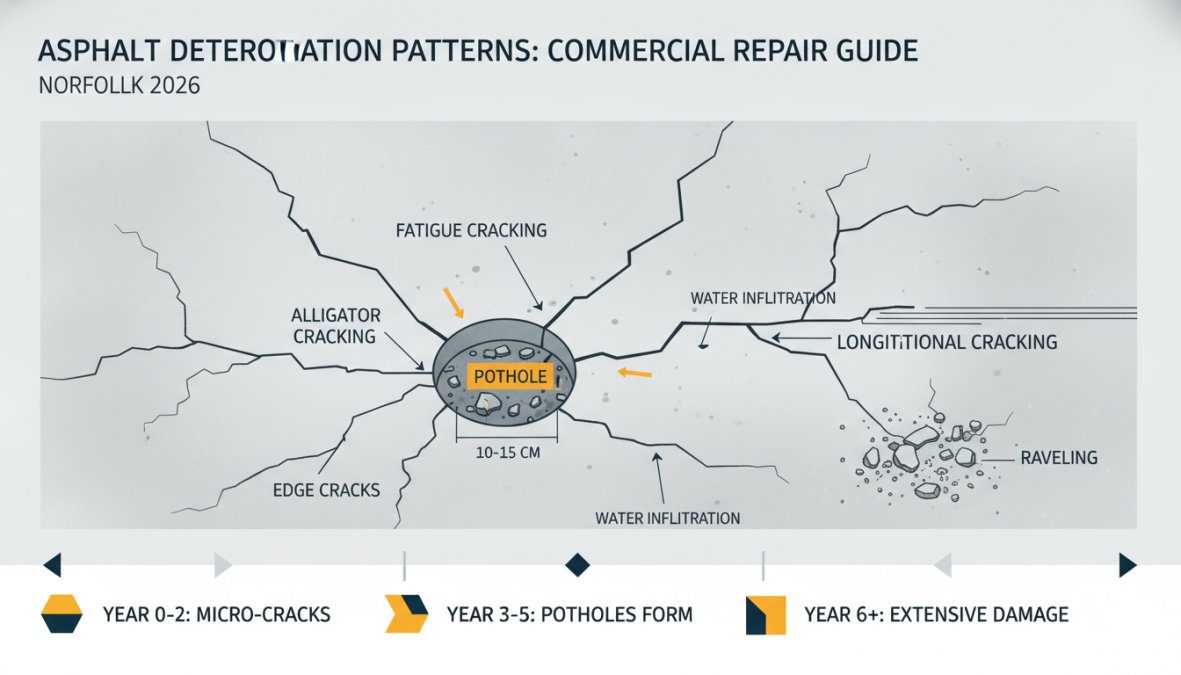
Medium cracks (1/4 inch to 1/2 inch) and small potholes require patching. This involves removing the damaged section, cleaning it thoroughly, and filling with hot mix asphalt. Patching buys you 3-5 more years if done early. Wait until potholes are 2+ inches deep, and you’re just delaying inevitable full-depth excavation.
Large cracks (over 1/2 inch), alligatoring patterns, and extensive potholes signal sub-base failure. Water has penetrated underneath, and the asphalt is breaking apart from below. At this stage, patching is cosmetic. You need full-depth excavation and milling, removing the entire failed section and rebuilding from the foundation up.
| Condition | Action | Timeline |
|---|---|---|
| Hairline cracks | Seal cracks | Immediate |
| 1/4-1/2 inch cracks | Crack fill and monitor | Within 30 days |
| Small potholes (under 2 inches) | Patch and plan resurfacing | Within 60 days |
| Large potholes or alligatoring | Full-depth excavation needed | Schedule within 90 days |
Delaying repairs on commercial asphalt in Norfolk is expensive. Each season of freeze-thaw cycles expands cracks exponentially. What costs $500 to repair in month one costs $3,000 by month six.
Parking Lot Resurfacing Timeline: Planning and Execution
Most Norfolk commercial parking lots need resurfacing every 10-15 years if maintained properly, or 6-8 years if neglected. The resurfacing process itself takes 3-5 days for a typical 10,000-square-foot lot, but planning takes longer.
Start planning 60 days before your target start date to get estimates, arrange financing, notify tenants, plan temporary access routes, and prepare the site.
The actual resurfacing work follows this sequence:
- Day 1: Site preparation. Crews clean the entire surface, remove loose debris, and mark off work areas.
- Day 2-3: Milling or removal. Old asphalt is removed or the top layer is milled away to create a smooth base.
- Day 4: Paving. New asphalt is laid in sections, compacted, and smoothed.
- Day 5: Line striping and sealing. Parking spaces, directional arrows, and ADA compliance markings are applied.
Full curing takes 7-10 days before heavy traffic resumes. Most contractors recommend waiting at least 48 hours before allowing vehicle traffic.
The total timeline from decision to fully operational parking lot is 75-90 days when properly planned. Rushing this process leads to premature failure and costly repairs.
Asphalt vs. Concrete for Commercial Use: Durability Comparison
Both asphalt and concrete work for commercial paving, but they perform differently in Norfolk’s climate and under different traffic conditions.
Asphalt is flexible and expands with temperature changes, handling Norfolk’s freeze-thaw cycles better than rigid concrete. It’s 30-40% cheaper to install per square foot, and repairs are simpler. However, asphalt requires more maintenance: sealcoating every 2-3 years, crack filling, and periodic patching. Over 20 years, maintenance costs can equal the initial installation cost.
Concrete is rigid and durable once installed, requiring minimal maintenance and lasting 25-30 years. It’s better for high-traffic, heavy-load areas like loading docks because it has higher load-bearing capacity. The trade-off: concrete is 40-50% more expensive to install, and when it fails, repairs are expensive and visible.
For most commercial parking lots in Norfolk, asphalt makes sense. It’s cost-effective, handles the climate well, and repairs blend seamlessly. For heavy-industrial areas or facilities expecting 20+ years of minimal maintenance, concrete pays for itself.
| Factor | Asphalt | Concrete |
|---|---|---|
| Initial cost (per sq ft) | $3-5 | $5-8 |
| Lifespan | 15-20 years | 25-30 years |
| Maintenance frequency | Every 2-3 years | Every 5-7 years |
| Repair visibility | Blends well | Visible patches |
| Load capacity | Good | Excellent |
| Freeze-thaw resistance | Excellent | Fair |
| Maintenance cost (20 years) | $1.50-2/sq ft | $0.50-1/sq ft |
The difference between a parking lot that lasts 20 years and one that fails in 7 comes down to installation quality and maintenance discipline. Durable commercial paving solutions Norfolk requires choosing the right material, finding experienced contractors, and committing to regular upkeep. KT Lake Paving and Landscaping brings 30 years of Norfolk experience to every project, with Brett Approved Premier Installer status and a 10-year product guarantee backing every installation. Get a free, no-obligation estimate today and see how proper paving protects your commercial property investment.
Frequently Asked Questions
What is the most durable type of commercial paving for Norfolk's climate?
Asphalt with quality sealcoating offers excellent durability for Norfolk's coastal climate, resisting moisture and salt spray. Stone Mastic Asphalt (SMA) provides superior load-bearing capacity for high-traffic areas. Concrete is also durable but requires more frequent maintenance in Norfolk's humid conditions. The best choice depends on traffic volume, budget, and long-term maintenance commitment. Consult local contractors for climate-specific recommendations.
How often should commercial parking lots be resurfaced in Norfolk?
Most commercial asphalt parking lots in Norfolk last 15-20 years with proper maintenance. However, high-traffic areas may need resurfacing every 10-15 years. Regular sealcoating every 2-3 years and prompt repair of cracks and potholes significantly extend pavement life. Annual inspections help identify when resurfacing becomes necessary, preventing costlier full-depth excavation later.
What factors affect the cost of durable commercial paving solutions in Norfolk?
Key factors include site size, existing pavement condition, required excavation depth, drainage needs, material selection, and traffic volume. Norfolk's coastal location may increase costs due to salt-resistant material requirements. Regulatory compliance and permitting also impact pricing. Getting free quotes from multiple local contractors helps establish realistic budgets and compare lifecycle costs rather than upfront price alone.
Are there eco-friendly commercial paving options available in Norfolk?
Yes. Permeable paving systems reduce stormwater runoff and support sustainable drainage management, important for Norfolk's water table. Recycled asphalt and reclaimed materials lower environmental impact. Resin-bound and tar & chip surfaces offer durability with reduced material waste. Many Norfolk contractors now offer these sustainable solutions, which often qualify for environmental incentives and improve ADA compliance simultaneously.


