

Table of Contents
- Cost of New Driveway Norfolk: What to Expect in 2024
- Best Driveway Materials for UK Weather & Norfolk Conditions
- Driveway Planning Permission UK & Norfolk Permit Requirements
- Gravel Driveway Installation Cost vs. Permanent Solutions
Last Updated: June 23, 2026
Understanding the cost of new driveway Norfolk is more straightforward than most homeowners expect, though final prices vary considerably. Norfolk’s ground conditions, weather patterns, and local contractor landscape shape quotes significantly. According to Which? consumer guidance on driveway installation costs, material choice is the single biggest variable, often accounting for more than half of the total quote.
Cost of New Driveway Norfolk: What to Expect in 2026
Driveway installation cost is the total price of labour, materials, sub-base preparation, and site clearance required to replace or install a new driveway surface. A standard single-car driveway covering roughly 30-40 square metres will cost considerably less than a double-width installation with drainage work.
Key cost drivers include:
- Driveway dimensions: Square footage is the primary cost multiplier.
- Tearout and removal: Existing concrete or tarmac needs breaking up and disposing of.
- Sub-base preparation: Norfolk’s clay-heavy soils require deeper aggregate base and careful compaction to prevent sinking and cracking.
- Material choice: Resin bound, tarmac, block paving, and gravel all carry different costs and labour rates.
- Drainage solutions: Permeable surfaces or channel drains add upfront costs but reduce long-term flooding risk.
| Material | Approx. Cost Per m² | Lifespan | Maintenance Level |
|---|---|---|---|
| Gravel | Low | 5-10 years | High (raking, topping up) |
| Tarmac / Hot Tar and Chip | Medium | 15-25 years | Low |
| Block Paving | Medium-High | 20-30 years | Medium |
| Resin Bound | Medium-High | 15-25 years | Low |
| Concrete Slab | Medium | 20-30 years | Low-Medium |
Always ask your contractor to itemise the quote: base layer, excavation, materials, and labour separately. Lump-sum quotes make it impossible to compare like-for-like across driveway installers.
Best Driveway Materials for UK Weather & Norfolk Conditions
Norfolk’s freeze-thaw cycles and clay soils that dominate the landscape create poor natural drainage and ground movement under temperature extremes. Your material choice should address these conditions before price enters the conversation.
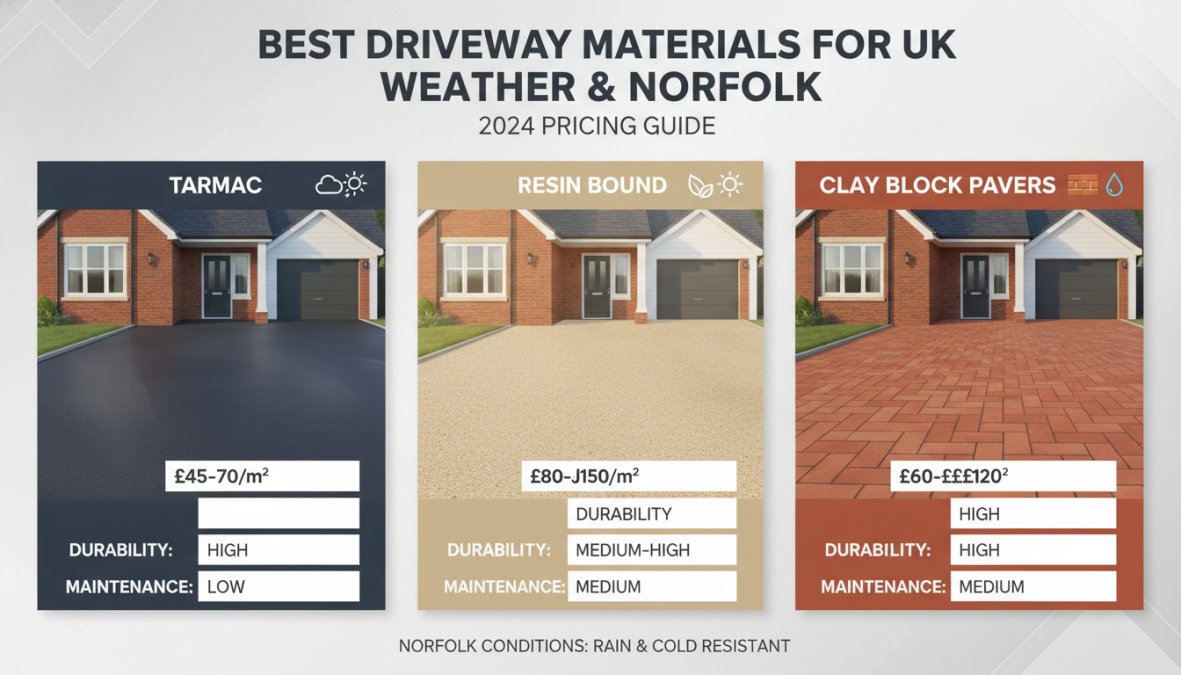
Resin Bound Surfacing is the strongest performer for Norfolk conditions. The material is permeable by design, meaning water drains through rather than pooling on the surface. This matters enormously on clay soils. Resin bound surfaces also resist frost heave better than rigid concrete slabs. KT Lake Paving and Landscaping specialises in resin bound installation as a Brett Approved Premier Installer, with a 10-year product guarantee.
Hot Tar and Chip (Tarmac) is the most established residential paving material in Norfolk. It handles freeze-thaw cycles well, repairs easily, and delivers excellent car clearance without the cracking that plagues concrete in cold conditions.
Block Paving offers strong curb appeal and individual unit replacement when damage occurs. On Norfolk clay, settlement over time is a risk if sub-base preparation isn’t done to a high standard.
Concrete Slabs are durable but rigid. Thermal expansion and ground movement create cracking risk unless deep sub-base preparation is carried out.
Avoid choosing a material based solely on the lowest square foot cost. A cheap gravel driveway installed without proper edging on clay soil will require topping up within two to three years, costing more over five years than a mid-range resin bound installation done correctly once.
Driveway Planning Permission UK & Norfolk Permit Requirements
Most driveway planning permission rules are straightforward once understood. Getting this wrong can result in enforcement notices.
As outlined in UK Government guidance on hard standings and planning permission, you do not need planning permission to pave over your front garden if the surface is permeable (water drains through it) or if rainwater is directed to a lawn or border rather than the road.
For Norfolk homeowners:
- Permeable surfaces (resin bound, permeable block paving, gravel): No planning permission required in most cases.
- Impermeable surfaces (standard concrete, non-permeable tarmac, solid block paving without drainage): Planning permission IS required unless drainage runs to a soakaway or lawn.
- Listed buildings or conservation areas: Additional consent may be required regardless of surface type.
Norfolk County Council and local district councils follow national permitted development rules, but local conditions, HOA covenants, and estate restrictions can add layers of compliance. Always confirm requirements with your local planning authority before work begins.
Choosing a permeable surface such as resin bound removes the planning permission requirement for most Norfolk properties and eliminates surface water run-off issues simultaneously.
Gravel Driveway Installation Cost vs. Permanent Solutions
Gravel is the cheapest option upfront and the most expensive over a decade. Gravel requires no specialist installation labour beyond excavation, membrane laying, and aggregate spreading, making it appealing as a quick, budget-friendly solution.
The problem is ongoing maintenance. Gravel migrates onto lawns and roads, requires periodic raking and redistribution, needs topping up every few years, and provides poor car clearance in wet conditions. Permanent solutions like resin bound and tarmac carry higher upfront costs but deliver a low-maintenance surface for 15-25 years. For total cost of ownership, permanent surfaces typically break even against gravel within five to seven years when maintenance costs are factored in.
The HomeOwners Alliance guide to driveway installation notes that a well-installed driveway can add measurable value to a property’s kerb appeal and market price, which gravel driveways rarely achieve.
DIY vs. Professional Installation
The DIY route is viable for gravel only. Resin bound, tarmac, and block paving all require specialist equipment and technical knowledge of sub-base depth, drainage gradients, and compaction standards. A poorly installed sub-base on Norfolk clay will fail within two to three winters.
For any permanent driveway in Norfolk, professional installation by a licensed and insured contractor is essential. Vet contractors carefully: ask for proof of public liability insurance, check whether they offer free estimates with written quotes, and confirm they work to British Standards. For resin bound specifically, Brett Approved installer status is a meaningful quality signal.
Choosing the right surface and contractor for a new driveway in Norfolk requires balancing upfront cost, local soil conditions, planning compliance, and long-term maintenance. KT Lake Paving and Landscaping brings over 30 years of local experience, Brett Approved Premier Installer status, and a 10-year product guarantee to every project, with free, no-obligation estimates and no deposit required.
Frequently Asked Questions
What is the average cost of a new driveway in Norfolk?
The cost of new driveway Norfolk varies by material and size. Asphalt typically ranges £15-25 per square foot, concrete £20-35, and pavers £25-50+. A standard 400 sq ft driveway costs £6,000-20,000 installed, depending on site conditions, sub-base preparation, and local labour rates. Free estimates from licensed Norfolk contractors provide accurate quotes based on your specific project requirements.
Do I need planning permission for a new driveway in the UK?
In most cases, residential driveway installation in the UK does not require planning permission if it uses permeable materials or covers less than 5 square metres. However, driveway planning permission UK rules vary, if you're using impermeable surfaces or your property is in a conservation area, you may need approval. Check with your local Norfolk council and review any HOA restrictions before starting excavation or installation work.
What factors affect the cost of a driveway in Norfolk?
Key factors influencing cost include: driveway dimensions and square footage, material choice (asphalt, concrete, pavers), site preparation and excavation depth, aggregate base and sub-base quality, soil conditions and drainage solutions, labour costs for installation, sealcoating or finishing treatments, and permit fees. Norfolk's clay-heavy soil may require additional compaction and drainage work, increasing project quotes compared to other regions.
Is gravel driveway installation cost cheaper than concrete or asphalt?
Yes, gravel driveway installation cost is typically the cheapest upfront option at £2-5 per square foot. However, gravel requires regular raking, topping, and maintenance every 2-3 years, making long-term costs higher than asphalt or concrete. For durability and lower maintenance, concrete or asphalt offer better value over 15-20 years, despite higher initial installation costs.


