

Table of Contents
- Resin Bound vs Block Paving for Small Driveways: Key Differences
- Installation Time and Professional vs DIY Feasibility
- Resin Bound Driveway Cost Per Square Metre and Long-Term Value
- Block Paving Maintenance Tips and Weed Prevention
Last Updated: July 14, 2026
When choosing between resin bound vs block paving for small driveways, homeowners face a decision that affects property value, maintenance demands, and long-term performance. At KT Lake Paving and Landscaping, we help Norfolk homeowners understand the real trade-offs between these two popular options based on installation time, long-term costs, maintenance demands, and durability.
Resin Bound vs Block Paving for Small Driveways: Key Differences
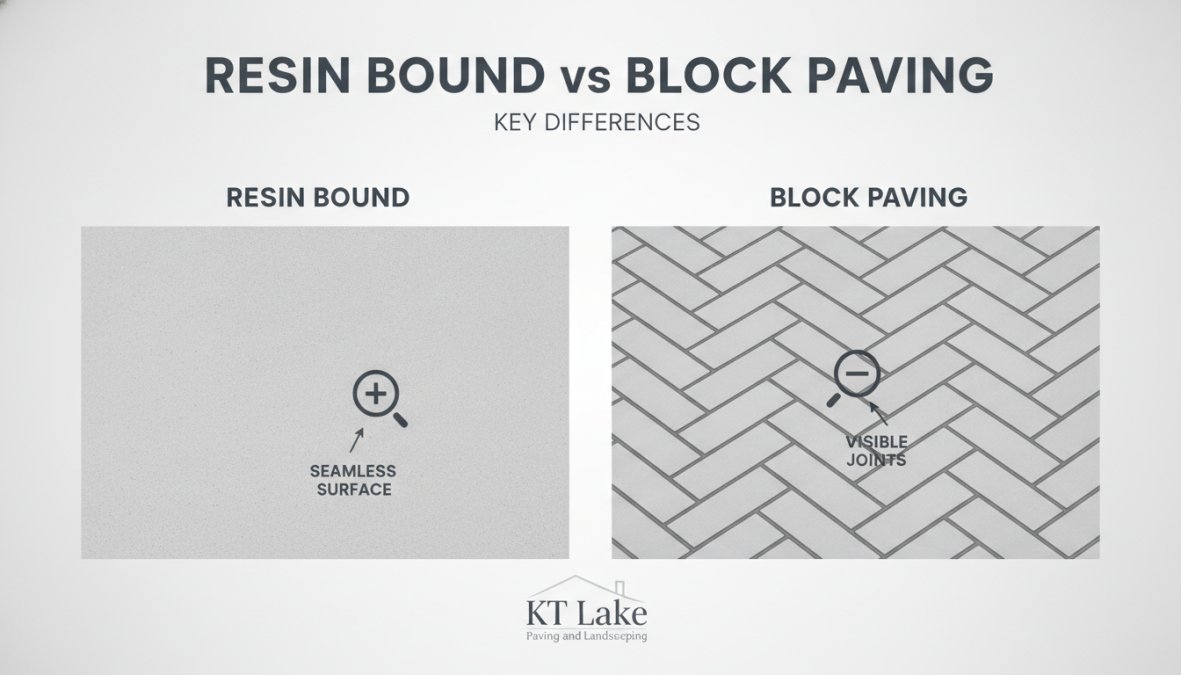
Resin bound paving creates a seamless, permeable surface by mixing natural stone aggregate with UV-stable resin, while block paving consists of individual concrete or natural stone units laid in a pattern with jointing sand between them.
For small driveways, resin bound offers a modern, uniform appearance with no gaps where weeds can grow. Block paving delivers a traditional aesthetic with visible joints and the ability to replace individual damaged blocks without resurfacing the entire driveway.
Both surfaces are SUDS-compliant and support sustainable surface water drainage when properly installed. Resin bound maintains its color better over time thanks to UV-stable resin, while block paving can fade or show efflorescence if not sealed properly.
| Feature | Resin Bound | Block Paving |
|---|---|---|
| Seamless finish | Yes | No |
| Weed growth risk | Minimal | Moderate to high |
| Maintenance level | Low | Moderate |
| Installation time | 2-3 days | 3-5 days |
| Repair approach | Resurfacing | Individual block replacement |
| Frost resistance | High | High |
| Load-bearing | Yes | Yes |
| Permeable/SUDS-compliant | Yes | Yes (with permeable jointing) |
Installation Time and Professional vs DIY Feasibility
Resin bound installation typically takes 2-3 days for a small driveway, while block paving usually requires 3-5 days. Both require professional installation, resin bound demands precise mixing, careful cure time management, and temperature control that DIY cannot reliably achieve. Block paving appears more DIY-friendly, but critical sub-base preparation determines long-term performance. Poor compaction leads to settlement and cracking within months.
For small driveways where mistakes are highly visible, professional installation is the practical choice for both options.
For small driveways in Norfolk, professional installation is the practical choice for both options. The driveway is a high-visibility surface, and poor groundworks create problems that cost far more to fix than initial installation savings.
Resin Bound Driveway Cost Per Square Metre and Long-Term Value
Resin bound costs more upfront than block paving, but the long-term value calculation is more complex. Installation costs for resin bound typically range higher per square metre, though pricing depends on aggregate selection, site access, and ground conditions.
The real cost difference emerges over time. Resin bound requires minimal maintenance, occasional sweeping and pressure washing. Block paving demands regular joint maintenance, weed prevention, and potential re-sanding every 3-5 years. Over a 10-year period, these maintenance costs accumulate significantly.
Resin bound can be resurfaced rather than completely removed, extending its life cost-effectively. Block paving repairs typically mean replacing individual blocks or sections, which becomes expensive if damage is widespread.
For small driveways, resin bound’s lower maintenance costs offset its higher installation price within 8-10 years. Block paving makes sense if you prioritize lower upfront cost and don’t mind regular maintenance.
Block Paving Maintenance Tips and Weed Prevention
Block paving maintenance is straightforward but requires consistency. Weed growth between blocks is the primary ongoing challenge, especially in small driveways where every weed is visible.
Effective weed prevention starts with proper installation using polymeric jointing sand, which hardens when exposed to moisture and resists weed growth better than standard sand. Regular pressure washing annually removes dirt and organic matter that encourages weeds. Proper edging prevents block migration and makes maintenance more effective.
For small driveways, block paving maintenance is manageable if addressed annually. Neglecting weed prevention for one season can result in deep-rooted weeds requiring mechanical removal or herbicide treatment.
Skipping weed prevention for one year can result in deep-rooted weeds that require mechanical removal or herbicide treatment, costing more than preventive maintenance would have.
Choosing between resin bound vs block paving for small driveways depends on whether you prioritize low maintenance and modern aesthetics or prefer traditional appearance with manageable upkeep. Resin bound offers a seamless, maintenance-free surface with excellent durability and SUDS compliance. Block paving delivers flexibility and a classic look at lower initial cost, though it demands regular attention to weed growth and joint maintenance.
KT Lake Paving and Landscaping specializes in both surfaces and brings over 30 years of experience helping Norfolk homeowners make this choice. As a Brett Approved Premier Installer, the team ensures every installation meets rigorous British Standards with a 10-year product guarantee. Get a free, no-obligation consultation and estimate to determine which surface delivers the best long-term value for your situation.
Frequently Asked Questions
Is resin bound cheaper than block paving for small driveways?
Resin bound typically costs more upfront than block paving, though pricing depends on quantity, dates, and delivery. However, for small driveways, resin bound may offer better long-term value due to minimal maintenance requirements and no weed growth between joints. Block paving requires regular cleaning, jointing sand replacement, and ongoing weed prevention. Contact KT Lake Paving for a free estimate to compare costs for your specific project.
What are the best block paving maintenance tips to prevent weed growth?
Regular maintenance is essential for block paving. Sweep the surface frequently to prevent debris accumulation, use polymeric jointing sand to fill gaps between blocks, and apply a weed killer or sealant annually. For small driveways, pressure washing twice yearly helps maintain appearance and prevents weed seeds from establishing. Removing weeds promptly when they appear prevents them from spreading through the sub-base.
Are resin bound driveways permeable and SUDS-compliant?
Yes, resin bound surfaces are highly permeable and SUDS-compliant, allowing surface water to drain naturally through the porous structure. This makes them ideal for sustainable water management and often eliminates the need for a dropped curb in areas with strict drainage regulations. Block paving can be permeable if installed with appropriate sub-base and jointing sand, but resin bound typically offers superior porosity and compliance with environmental standards.
How long do resin bound and block paving driveways last on small properties?
Resin bound typically lasts 15-20 years with minimal maintenance when installed on a stable sub-base. Block paving lasts 20-25 years or longer but requires consistent upkeep. For small driveways, the actual lifespan depends heavily on installation quality, climate exposure, and maintenance. UV-stable resin resists color fading better than standard block paving over extended periods. A Brett Approved Premier Installer like KT Lake Paving ensures your surface meets rigorous British Standards for longevity.
Can I DIY resin bound or block paving installation on a small driveway?
Block paving is more DIY-friendly for small areas if you have experience with groundworks and sub-base preparation, though professional installation ensures proper load-bearing and drainage. Resin bound requires specialist equipment, technical expertise, and precise mixing of UV-stable resin with aggregate stones, mistakes compromise the seamless finish and durability. Professional installation protects your investment and maintains warranty coverage, particularly important for small spaces where errors are visible.


